
The origins of the Cinderella Ballet are found in the fairy tale written by the Italian Giambattista Basile La Gatta Cenerentola published in 1634 within the Il Pentamerone collection. Charles Perrault (Paris, 1628-1703) adapted this version in 1697, which, along with the story of Sleeping Beauty, is one of the eight stories collected in his book Stories and Tales from the Past, also known as Tales of Mother Goose.

Table of Contents
Key Facts about Cinderella Ballet
The story of Cinderella has been told countless times through operas such as La Cenerentola by Gioachino Rossini (1817) and Cendrillon by Jules Massenet (1899). Also in many films for cinema and television, perhaps the most popular is Walt Disney’s animated version from 1950.
- Release date: November 21, 1945. Bolshoi Theater Moscow
- Composer: Sergei Prokofiev
- Original choreography: Rotislav Zakharov
- Libretto: Nikolai Volkov, based on the fairy tale by Charles Perrault
- Performer: Originally played by Olga Lepeshinskaya, it was Galina Ulanova who became legendary in the title role
Cinderella Ballet: How a Fairytale Became a Dance Classic
Cinderella not only had literary versions. Theatre, opera, pantomime and ballet also knew how to narrate it with different nuances.
A Tale of Two Cinderellas: Strauss vs. Petipa
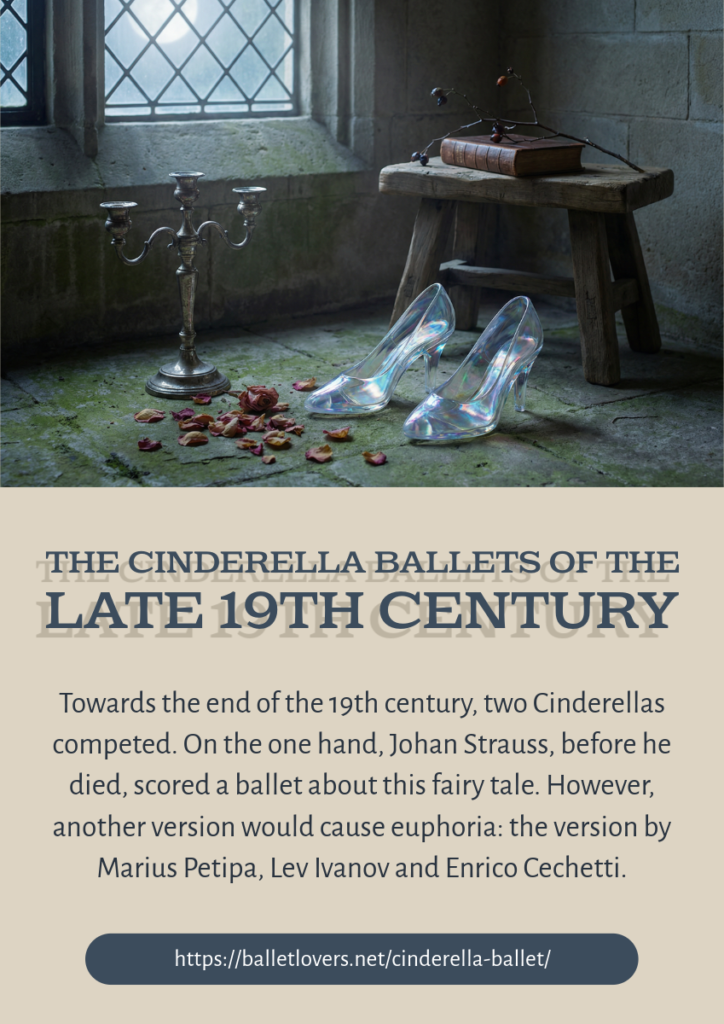
It is believed that 1813 was the first time a choreographer used a story by Perrault to create a complete ballet. The first production was made in Vienna by Louise Antoine Duport. Towards the end of the 19th century, two Cinderellas competed.
On the one hand, Johan Strauss, before he died, scored a ballet about this fairy tale. However, despite the popularity of Strauss’s music, it would be another version that would cause euphoria. And it would establish a milestone in the history of dance: the version by Marius Petipa, Lev Ivanov and Enrico Cechetti. This version was created for the Imperial Mariinsky Theater of Russia, with music by the baron Boris Fitinhof Schell.
It was 1893 and for the first time, a dancer, the Italian Pierina Legnani, performed thirty-two successive rond de jambes fouettés en tournant. The Russian critic Konstantin Skalkovsky described the ovation that the public gave the dancer, asking him to repeat her feat. From then on, counting the prima ballerina’s fouettés would become “the public’s favourite occupation,” Skalkovsky predicted.
Prokofiev’s Return: A New Cinderella for Post-War
Despite its success, Petipa/Ivanov’s choreography and Fitinhof–Schell’s music were lost over time. Several years later, in 1945, another Cinderella premiered at the Bolshoi Theater in Russia, choreographed by Rotislav Zakharov. In the early 1940s, Sergei Prokofiev was commissioned to write the score, following his success with the ballet Romeo and Juliet. But because of the war, the composer had to postpone the task.
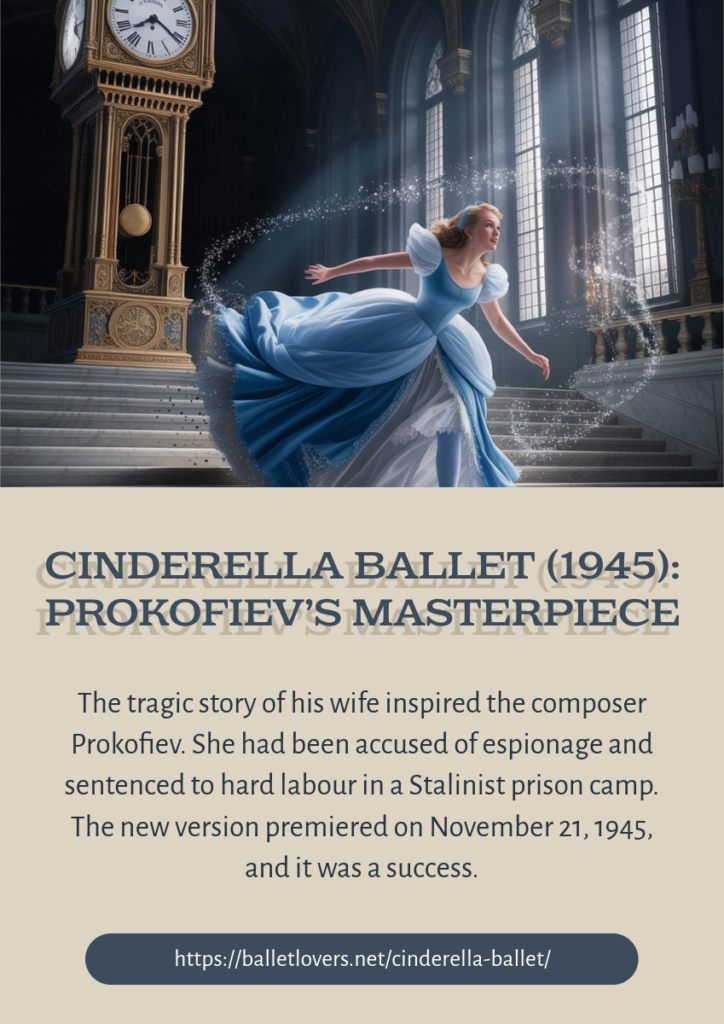
Only in 1944, did Prokofiev please return to the Soviet Union. So, he was able to finish the task there. The tragic story of his wife inspired the composer. She had been a Spanish woman accused of espionage and sentenced to hard labour in a Stalinist prison camp. Prokofiev wrote in his diary, “Cinderella is Lina.” The new version premiered on November 21, 1945, and it was a success. Russian dancer Galina Ulanova played the role of Cinderella. Some people interpreted the work in political terms.
In 1945, the Allies defeated the Axis forces. And the work taught how good triumphed over evil. But the production had much more naive intentions. Despite the personal moment that the composer was going through, the music was jubilant. And the stepsisters were more crazy than evil. This made Cinderella a play to enjoy with the family.
Ashton and Stevenson: Reinventing Cinderella Ballet for a New Era
Prokofiev’s work offered the entire structure of a great classical ballet: variations, adagios, pas de deux. This was how Tchaikovsky had traditionally organized the great works for Petipa. For this reason, throughout the 20th century, other choreographers became interested in the score.
In 1948, Frederick Ashton created a version of Cinderella that would become a synthesis of British ballet. But the most popular version was that of the Englishman Ben Stevenson, who developed his career in the United States. Stevenson created the work at the request of the former National Ballet in Washington in 1970.
Many think the reason for its success is the way it combines romance and comedy. The decision to have the stepsisters performed by male dancers contributed to the development of parody humour. But, fundamentally, Stevenson managed to make the story the true protagonist. In other words, characters move the story forward through movement.
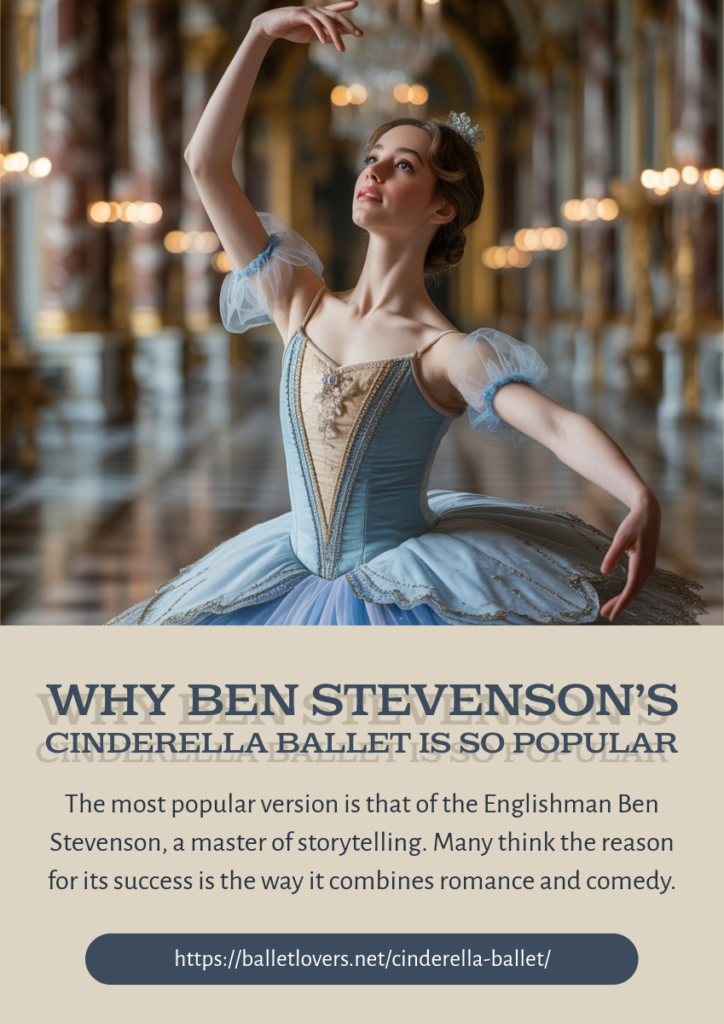
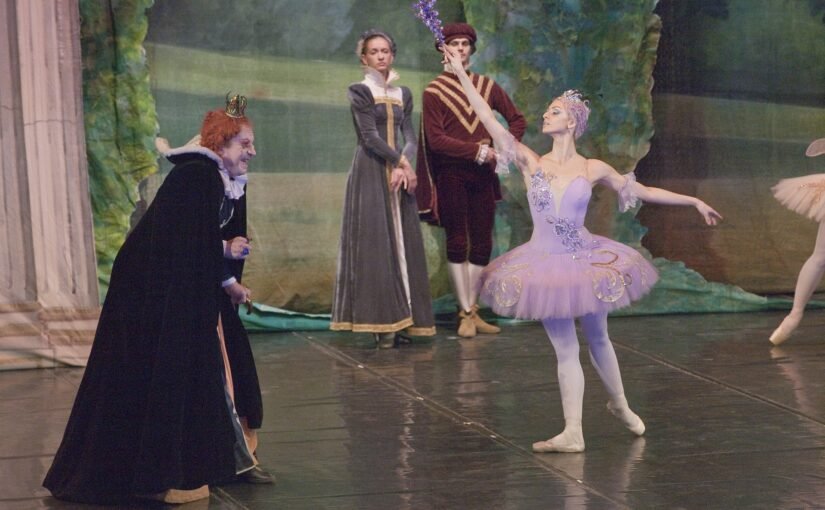
And the staging collaborates to result in a magical Cinderella. The play contains all the necessary ingredients: the pumpkin, the carriage, the fairy godmother, the evil stepmother and the glass slipper.
Choreographer Dominic Walsh believes that “Stevenson is a master of storytelling.” Each movement is motivated by the temperament, mood, expression and intention of the characters, according to Walsh.
This is a challenge for dancers. But this is what makes classical ballet so moving and powerful.” Stevenson’s Cinderella is a perfect example of classicism in ballet. It is a work rich in drama, humour, charm and wit.
Cinderella Ballet Story
The ballet has three acts that we detail below:
Act I
Cinderella is a young woman whose stepmother forces her to work as a maid in their own home. So, she helps her stepmother and her two stepsisters prepare for the ball, where the prince will choose his future wife. The stepsisters work together on a shawl, but break it after arguing with each other.
Suddenly, a beggar woman appears. So, Cinderella takes pity on her and offers her a place by the fire and a piece of bread. The beggar woman leaves after thanking Cinderella for her hospitality. Meantime, the stepmother and her daughters choose dresses and take a quick dance lesson. Later, they set off and leave Cinderella behind. Once alone, Cinderella dreams of the palace ball.
The Fairy Godmother, who is none other than the beggar, makes her appearance dressed in a beautiful dress and accompanied by the fairies of spring, summer, autumn and winter. Then, she performs the Cinderella transformation. She turns Cinderella’s rags into a beautiful dress and her old slippers, in glass slippers. A chariot pushed by beautiful horses completes her transformation.
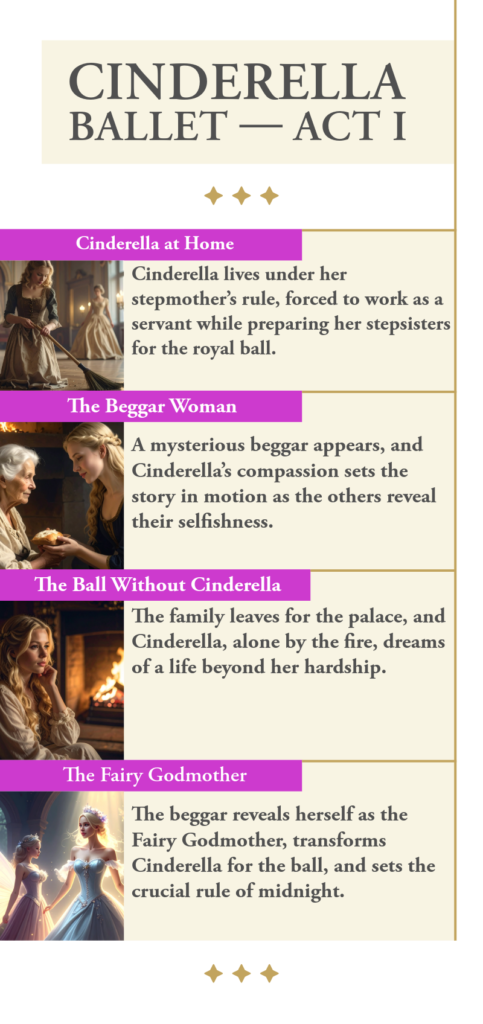
The Fairy warns Cinderella that the effect of the magic spells will cease at midnight. So, if she does not leave the palace in time, she will find herself dressed in her old clothes again.
Act II
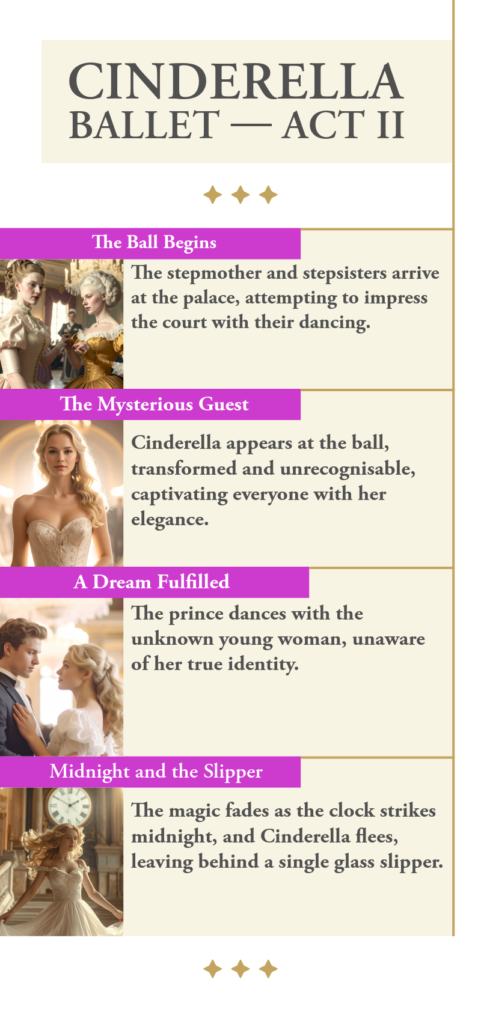
When the dance in the palace has already begun, Cinderella’s stepmother and her daughters arrive. The two sisters try to curry favour with the court by displaying their dancing skills. But they have less than successful results, much to their mother’s dismay. Unexpectedly, Cinderella appears so dazzling that her stepmother and stepsisters do not recognise her.
The prince is captivated by the elegance and beauty of the young woman and dances with her. Cinderella is happy because her dreams have come true. Meanwhile, the clock begins to strike midnight. And Cinderella remembers the Fairy’s warning and runs out of the palace.
But in her haste, she loses one of her slippers. The prince runs after her but does not catch up with her. He only finds a small slipper that can help identify the mysterious young woman.
Act III
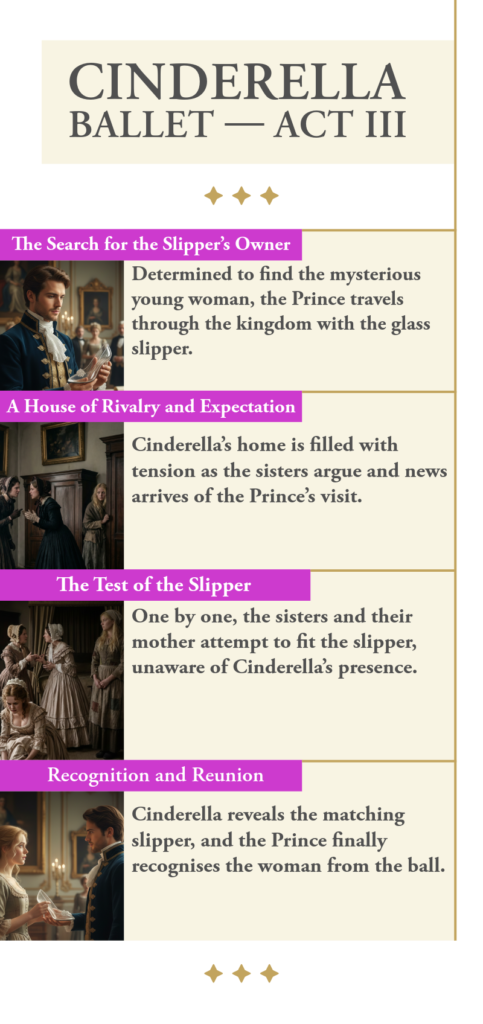
The Prince is desperate. He wants to find the beautiful young woman who owns the slipper. Since the shoemakers of the kingdom cannot identify the little slipper, the Prince starts to search for the unknown young woman. Meantime, Cinderella remembers the previous night. She guesses it was not a dream since she only has one of the slippers. The sisters appear and continue fighting with each other. But their fight is interrupted when news arrives that the Prince is heading to their house. When he arrives, he does not recognize the mysterious young woman in the sisters.
They try to put their foot in the slipper in vain. Even the stepmother decides to try it on. In the meantime, Cinderella hides in her corner and drops the other slipper. Then, the surprised Prince looks at her and identifies the young woman he has been looking for. The stepmother and the sisters cannot recover from their astonishment. Finally, Cinderella and the Prince dance to a romantic melody full of emotion and happiness.
Ballet with music by Sergei Prokofiev
Cinderella is the second classical ballet that Prokofiev composed after the success of the ballet Romeo and Juliet (1938). The process of creating the Op. 87 score was very long. He began working on it in 1940 and continued it throughout the war years in parallel with the opera based on Leo Tolstoy’s novel War and Peace. The premiere of the three-act ballet took place at the Bolshoi Theater in Moscow on November 21, 1945.
The ballet Romeo and Juliet generated controversy because of its rhythmic complexity. So, dancers believed it was impossible to dance. Then, Prokofiev decided on the ballet of The Cinderella and returned to the traditional works of Russian ballet such as those created by Tchaikovsky.
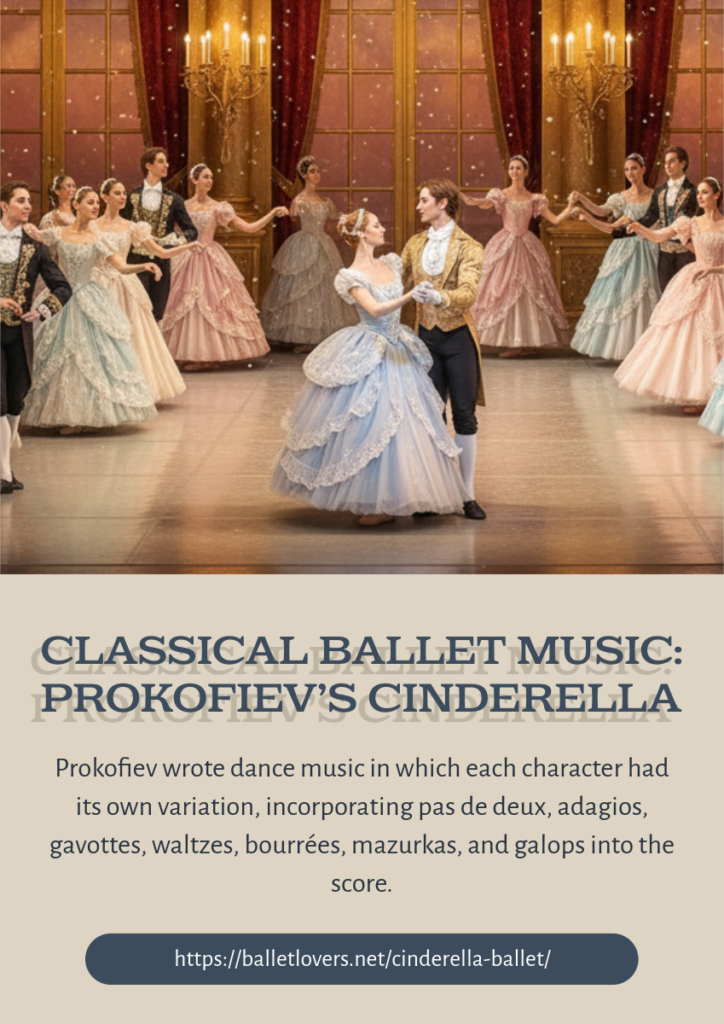
He wrote dance music in which each character had its own variation, incorporating pas de deux, adagios, gavottes, waltzes, bourrées, mazurkas, and galops into the score.
He composed a piece of brilliant music as passionate and romantic as the Romeo and Juliet ballet. However, it has an element that makes it different, as it incorporates magic into the plot. Cinderella stands out for its happy music, sometimes with brio, romantic, ironic. But it always conveyed emotion in each of its characters and each setting.
From the work, the year after its premiere, three orchestral suites from the ballet emerged that have become concert favourites based largely on the piano pieces Opus 95 and Opus 97. They were reworked in symphonic form, which includes almost half of the ballet’s music, twenty-two of the fifty total numbers:
Cinderella Suite No. 1, Op. 107 (8 pieces); Cinderella Suite No. 2, Op. 108 (6 pieces); Cinderella Suite No. 3, Op. 109 (8 pieces).
Different versions of Cinderella Ballet with music by Prokofiev
Many choreographers have adapted the ballet, adapting Zakharov’s choreography or creating other versions with different themes or tempos
- Konstantin Sergeyev (1946) at the Bolshoi Theatre
- Frederick Ashton (1948), Sadler’s Wells Ballet, Royal Opera House. It was the first complete production with music by Prokofiev in the West. It introduced the novelty of the grotesque role of the stepsisters played by men. The following year the principal performer was Margot Fonteyn.
- Ben Stevenson (1970) for the Washington National Ballet, the stepsisters are also played by men
- Rudolf Nureyev (1986) for the Ballet de l’Opéra National de Paris. He makes a new version adapting the story to Hollywood stardom and the dream of its heroine, a role played by Sylvie Guillem
- John Neumaier (1992) for the Hamburg Ballet
- Michael Corder (1996) for the English National Ballet
- Matthew Bourne (1997)
- Alexei Ratmansky (2002) for the Mariinsky
- James Kudelka (2004) for The National Ballet of Canada
- David Bintley (2010) for the Birmingham Royal Ballet
- Christopher Wheeldon (2012) for the Dutch National Ballet.
Buy Cinderella Ballet DVD / Blu-Ray
Sadler’s Wells Royal Ballet: Fonteyn – Somes
Buy on Amazon USA Buy on Amazon UK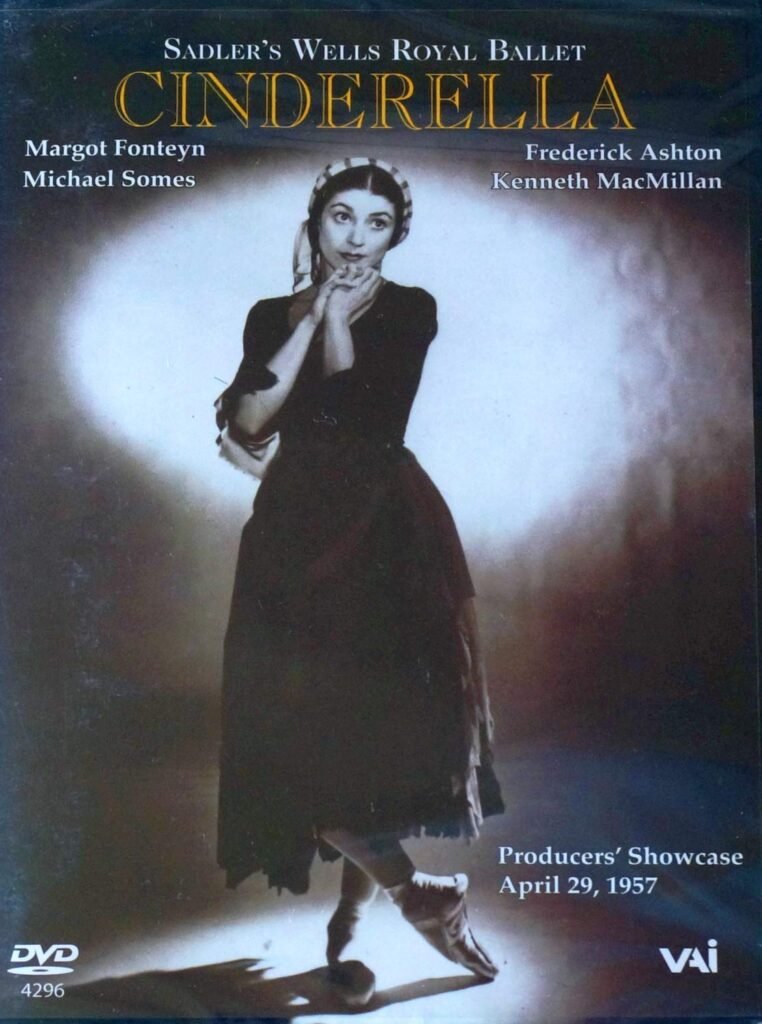
- Media Format : NTSC, Multiple Formats, Black & White, Classical, Closed-captioned
- Run time : 1 hour and 27 minutes
- Release date : August 31, 2004
- Actors : Margot Fonteyn, Kenneth MacMillan, Frederick Ashton


Leave a Reply