
The fouette is one of the most versatile movements in the classical ballet vocabulary. So, the term “fouetté” applies to a broad family of movements that share a common characteristic: a powerful whipping action of the leg or foot. These steps are essential in both adagio and allegro sequences. They range from small connecting movements to dazzling turns. One of the most famous examples is undoubtedly the Grand Pas de Deux from Act III of Swan Lake, where Odile executes 32 fouettés. In this article, we’ll explain the main variations of this movement and practical tips for achieving a flawless fouetté.

Table of Contents
Meaning of the word fouette and its diverse family
The French term fouetté literally means “whipped.” This definition perfectly describes the energetic nature of the movement. According to ballet dictionaries and manuals, fouetté can describe:
- A sharp, whip-like movement of the active leg or foot
- Or a whip-like rotation of the entire body to change direction.
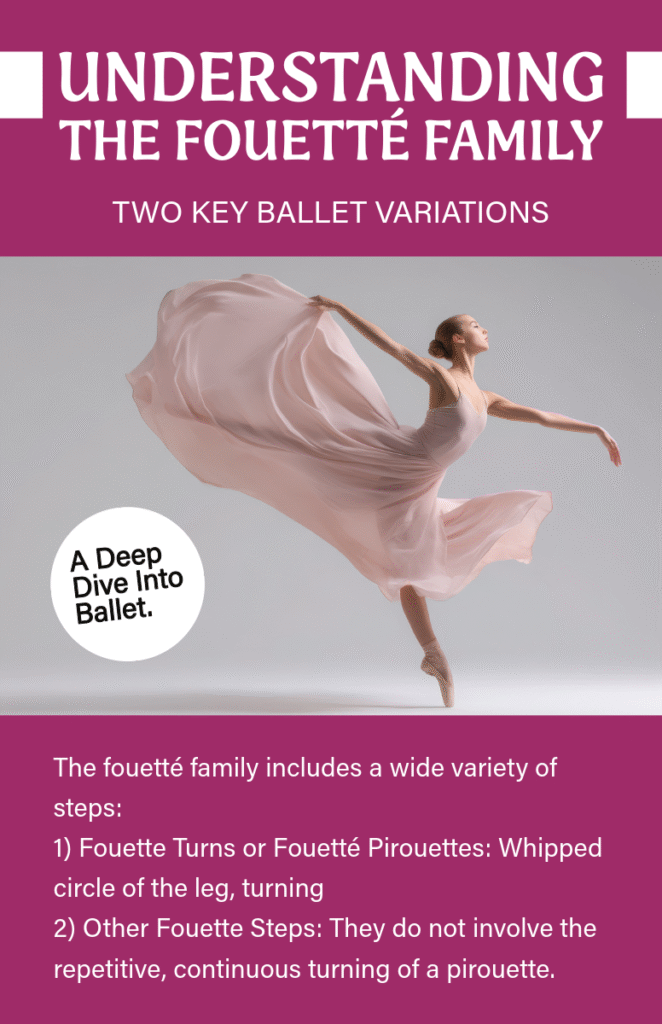
The fouetté family includes a wide variety of steps. For clarity, we can group them into two main categories:
A. Fouetté Turns (or Fouetté Pirouettes). This is perhaps the best-known step in this family. Commonly abbreviated as fouettés, its full name is usually fouetté rond de jambe en tournant (“whipped circle of the leg, turning”). The whipping action of the leg propels the dancer into a pirouette.
B. Other Fouetté Steps (Adagio/Allegro Movements Without a Turn). This group includes movements that involve a sharp, whipping motion of the entire body to change direction, usually from a spread to an arabesque or attitude line. These can be performed jumping, relevé (on demi-pointe), or with the whole foot in a combination of adagios (a kind of promenade). However, they do not involve the repetitive, continuous turning of a pirouette. Some examples are the grand fouetté en tournant (when performed as a single turn into an arabesque pose) and the petit fouetté.
Fouetté Turns
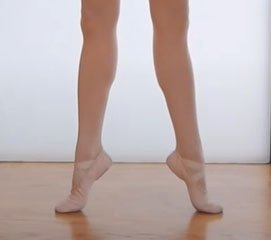
In this dynamic movement, the dancer spins continuously. The supporting foot rises onto pointe with each turn to facilitate rotation, while the arms and legs create broad movements and then quickly retract to generate and renew the propelling momentum.
These uninterrupted turns are true acrobatic feats. They can be performed as single or double turns — up to thirty times or even more, depending on the performer’s strength and training.
How to Do Fouette Turns
1) Start in the fourth position, right foot back. Place your right arm in the first position and your left arm in the second.
2) Execute a pirouette en dehors on the left leg, arms in the first position.
3) Fondu on the left and open your right leg to the front. Left arm in the second position and right arm in the first position.
4) Move your right leg and your right arm to the second position.
5) Left foot in relevé, arms in the first position and perform a pirouette en dehors on the left leg.
6) Repeat from 3) for series.
Tips for Mastering the Fouetté Turn
1. Alignment and Control
- The center of gravity must be precisely aligned over the supporting leg.
- Your shoulders and thighs should remain level at all times.
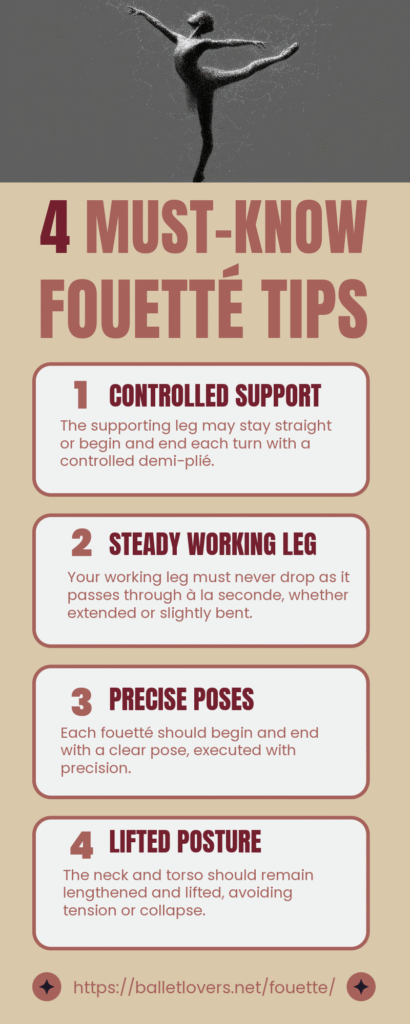
- The supporting leg may stay straight or begin and end each turn with a controlled demi-plié. Avoid collapsing forward.
- Your working leg must never drop as it passes through à la seconde, whether extended or slightly bent.
- The passé position is formed by a firmly held thigh that simply bends at the knee—never by lifting or lowering the entire leg.
- Each fouetté should begin and end with a clear pose, executed with precision, purpose, and expressive energy.
2. Coordination of the Arms, Head, and Body
Your arms, body, and head may vary slightly in style depending on the school or choreography. However, they must always conform to the principles of port de bras. So, you should coordinate your arms with the turns.
During the turn:
- The arms open and close in harmony with the leg movement, maintaining balance and rhythm.
- The head must spot at eye level to control rotation and prevent dizziness.
- The neck and torso should remain lengthened and lifted, avoiding tension or collapse.
3. Control of the Working Leg
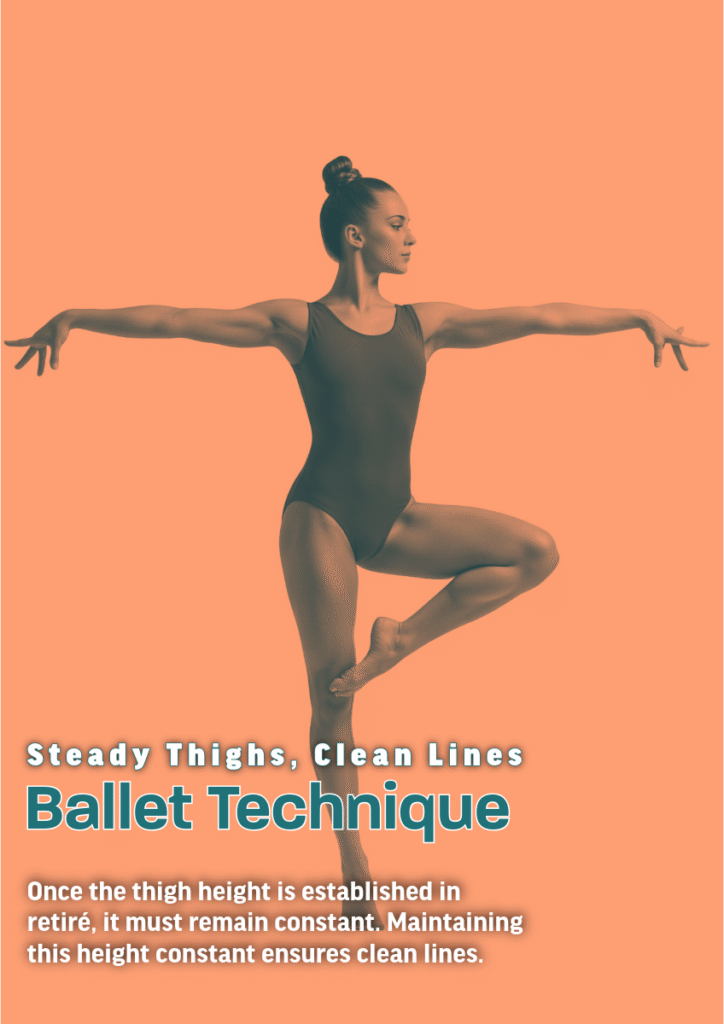
The thigh of the working leg (the whipping leg) should not move up and down when opening and closing the leg. Once the thigh height is established in retiré, it must remain constant. It should not drop when opening forward nor rise when closing to initiate the turn.
While the precise height varies slightly from dancer to dancer, it should generally be maintained between 60° and 90°. Maintaining this constant height ensures clean lines, efficient rotation, and a stable centre of gravity. To sum up, keep the working leg at the same level; do not allow it to drop or lift.
Last but not least, remember to maintain the turnout of the working leg.
Other Fouette Steps
1) Grand fouette en tournant en dedans
This exercise has several names (including grand fouetté en tournant) and can also be performed in a variety of ways. Below is a description of one of the simplest versions:
1) The step begins from the first arabesque with the right leg.
2) Pass the back leg forward through first position demi-plié.
3) Do a Grand Battement Devant with the right leg.
4) As soon as the right leg reaches its maximum height, perform a half turn to the left (en dedans) on the left foot, until the right leg is in the first arabesque.
5) To finish the step, lower the straight right leg, and as the right foot reaches the floor, perform a demi plié.
2) Grand fouette en tournant en dedans with relevé
1) To begin with, place your right foot in pointe tendue derriere, with your arms in the second position.
2) Pass the back leg forward through first position demi-plié, lowering your arms in the preparatory position.
3) As you do a Grand Battement Devant with the right leg, do a relevé with your left leg. This movement is also known as ” Grand battement relevé devant”. On the other hand, lift your arms through 1st to 5th position.
4) As soon as the right leg reaches its maximum height, perform a half turn to the left (en dedans) on the left foot relevé, until the right leg is in the first arabesque in relevé. Open your arms outward to the 1st arabesque line.
5) To finish the step, lower your left foot controlly into demi plié.
You Might Also Like ✨
3) Grand fouette saute en tournant en dedans
1) Start the movement with a tombé en avant and your arms in the preparatory position.
2) Bring your right leg through 1st into grand battement devant and lift your arms through the first position.
3) As soon as the right leg reaches its maximum height, lift your arms to the fifth position and turn jumping to the left.
4) Land on your left leg in plié in arabesque, maintaining the height of the leg with the weight well forward and the upper back strongly held. On the other hand, remember to keep your shoulders pressed down.
Fouetté Technique: Expert Tips
Mastering the fouetté requires precision in leg movement, body alignment, and arm coordination. These guidelines apply to all variations:
1. Arm Coordination (Port de Bras)
Carefully synchronise your arms with each phase of the fouetté. This will help you improve your balance, momentum, and line.
As a summary, here is a step-by-step reminder of the arm sequence:
1) As the leg passes through the first position in demi-plié: Lower the arms to en bas (preparatory fifth position).
2) During the grand battement devant: Raise the arms through en avant (low first position), then to en haut (fifth position overhead).
3) As the turn begins: Open the arms outward, following the line of the arabesque.
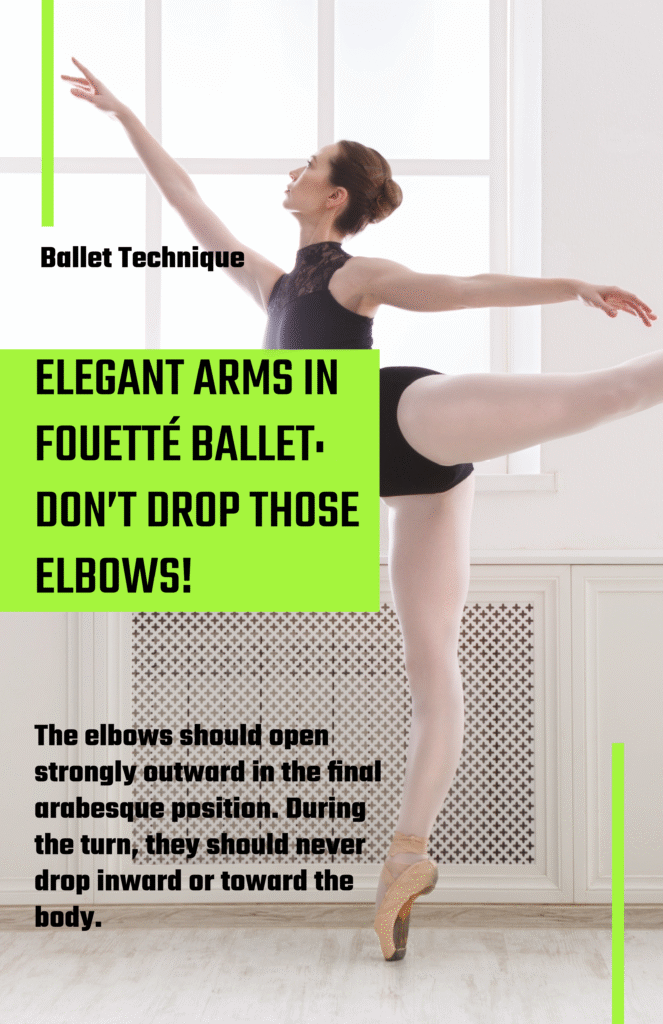
On the other hand, the elbows should open strongly outward in the final arabesque position. During the turn, they should never drop inward or toward the body.
Finally, the posture requires extension, not tension. This extension should be reflected in the fingertips of both hands.
2. Control the Spine and Pelvis Throughout the Movement
If you are an intermediate dancer, keep your spine firmly upright during the grand battement devant. Advanced dancers may lean slightly backward for greater amplitude. However, beginners and intermediate dancers should avoid this to develop core stability.
In the final arabesque position, tilt your pelvis slightly forward to help keep your leg at the same height as in the grand battement devant.
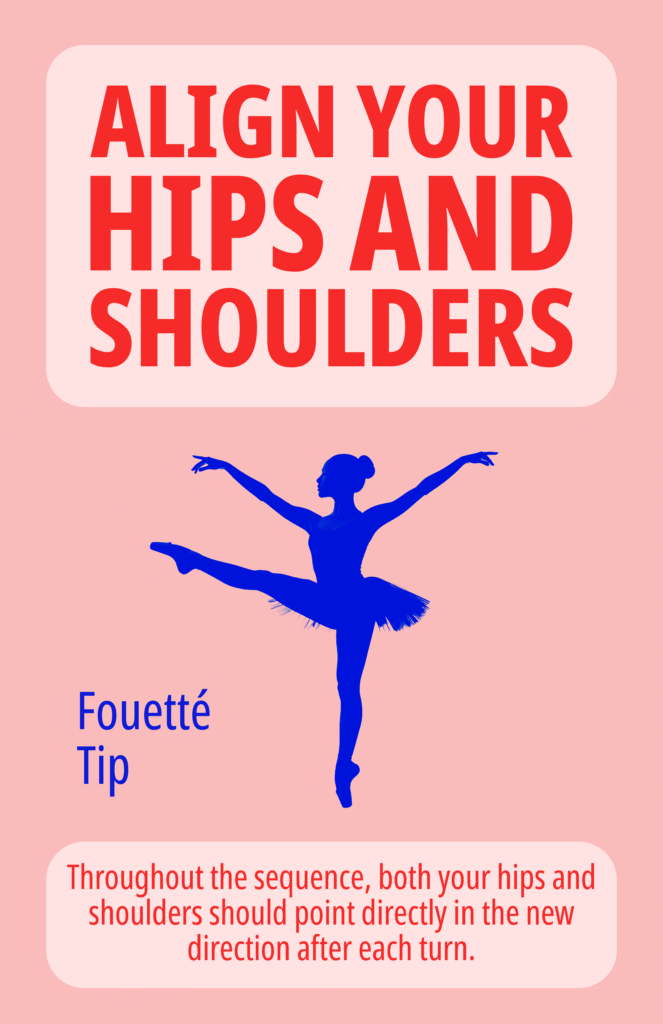
Throughout the sequence, both your hips and shoulders should point directly in the new direction after each turn. This requires precise timing and coordination of your arms and torso.


Leave a Reply