
The Firebird Ballet is one of the most important ballets of the 20th century. Known in French as “L’Oiseau de Feu” and in Russian as “Zhar-ptitsa”, it is a fundamental work of modern dance that premiered on June 25, 1910, at the Théâtre National de l’Opéra in Paris. Performed by Sergei Diaghilev’s Ballets Russes, it was the first ballet score by composer Igor Stravinsky. This work was characterised by a profound collaboration between choreographer Michel Fokine, composer Igor Stravinsky, and designers Aleksandr Golovin and Léon Bakst. The ballet, in one act and two scenes, draws inspiration from Russian fairy tales, combining elements of magic and the struggle between good and evil.
The Firebird quickly established itself as an iconic work. Its success in Paris was immediate, captivating both audiences and critics.
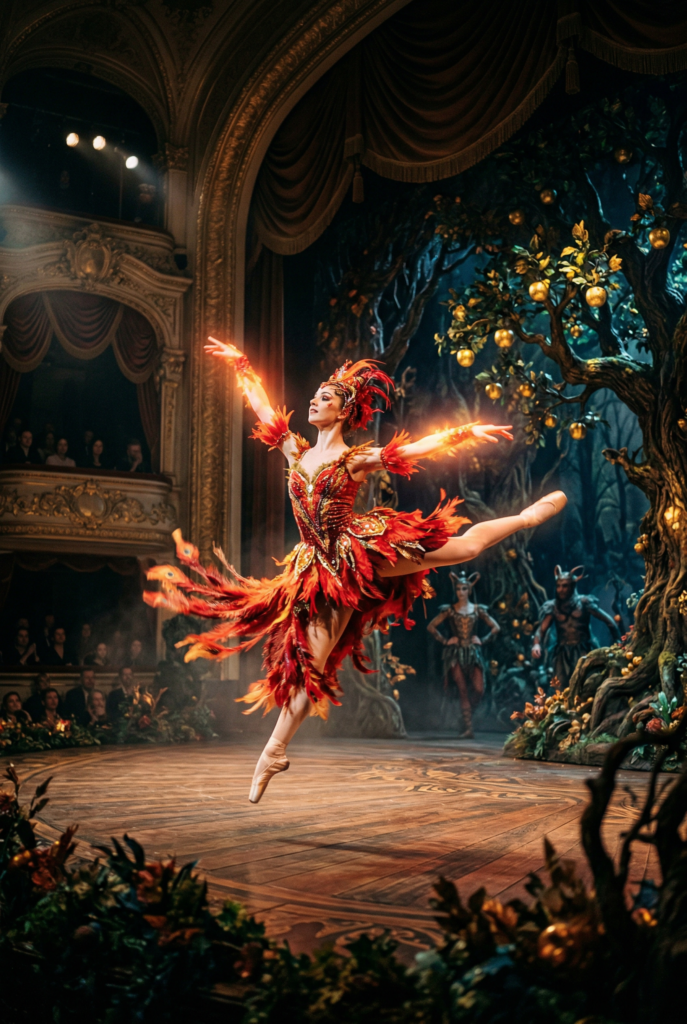
Its libretto, innovative score, elaborate sets, and dramatic choreography combined to create an unforgettable spectacle that embodied the original spirit of the Ballets Russes. The creation of the lead role, performed by the talented Tamara Karsavina, was also a highlight. Also, this ballet boosted Stravinsky’s career as a ballet composer and solidified Fokine’s reputation as a choreographer. Keep reading the article to learn more about its plot and creation.
Table of Contents
Plot of the Firebird Ballet
The libretto, conceived by the Russian choreographer Michel Fokine (1880-1942), is an adaptation of several Russian fairy tales, including “The Tale of Ivan Tsarevich and the Bird of Light and the Grey Wolf” and the legend of the immortal sorcerer Kastchei.
In this work, Fokine clearly established the opposition between good and evil upon which so many fairy tales are based. So, Kastchei the Immortal and his Impure Kingdom are the embodiment of evil and ugliness. On the contrary, the Firebird is a wondrous creature of light and beauty, with the power to uplift and transform the world. On the other hand, Prince Ivan and the princesses represent the social structure of humankind, those for whom the fantastical forces of good and evil struggle. So, Prince Ivan Tsarevich is the traditional fairy tale hero, possessor of a magical object, a feather from the Firebird, which makes him invincible.
The Enchanted Garden and the Golden Feather
The ballet begins with an overture that creates an atmosphere of witchcraft and magic: low murmurs, mysterious wails, the footsteps of gnomes, whispers, distant thunder, and the trembling hum of wings. As the curtain rises, the stage is dark, except for a central tree bathed in amber light, its branches laden with golden fruit.
The scene brightens, revealing a forest. A bird, resplendent with an orange glow, flies across the background. Prince Ivan Tsarevich enters the enchanted garden, climbs a wall, and cautiously explores the surroundings.
With a crossbow in his hand, the prince aims at the firebird, but misses twice. On the third attempt, as the bird plays among the golden leaves, Ivan catches it in his arms.

In exchange for its freedom, the bird gives the prince a magical golden feather, promising to come to his aid should he ever be in danger.
The Captive Princesses and Kastchei’s Domain
Ivan releases the bird and is about to leave when twelve maidens—enchanted princesses—descend a staircase through gates and begin playing with the golden apples of the magic tree. Among these princesses is the beautiful Tsarevna (or Princess of Unreal Beauty), and Ivan falls hopelessly in love with her. The princesses shake the magic tree, causing golden apples to fall, and they toss them to one another.
Ivan emerges from his hiding place, bows, and the Tsarevna warns him to leave, for they are captives in the domain of the evil sorcerer Kastchei, who turns intruders to stone. Already in love, Ivan refuses to go. Suddenly, the maidens flee through the gates, which slam shut. Darkness descends, trapping Ivan. The prince shakes the gates, which burst open.

A light flashes, and a horde of demons, goblins, monsters, kikimoras, and other grotesque creatures descends from the hill and seizes him.
The Destruction of the Egg and the Final Triumph
Kastchei appears with his retinue and attempts to cast a spell on Ivan, but the prince waves the golden feather. Then, the Firebird comes to his rescue, scattering the enemies. A dance begins, its rhythm ever faster, forcing the monsters to dance until they collapse from exhaustion and fall into a deep sleep. The bird guides Ivan to a tree where he finds an iron chest containing an enormous egg: Kastchei’s soul. Ivan tosses the egg into the air, catches it, and finally smashes it against the ground. A deafening crash follows, and darkness falls upon him.
When the light returns, the spell is broken. So, Kastchei, his court, and the monsters have vanished. The petrified knights come back to life; noble and beautiful ladies appear, freed from the enchantment. A procession of pages brings a crown, a sceptre, and an ermine robe.
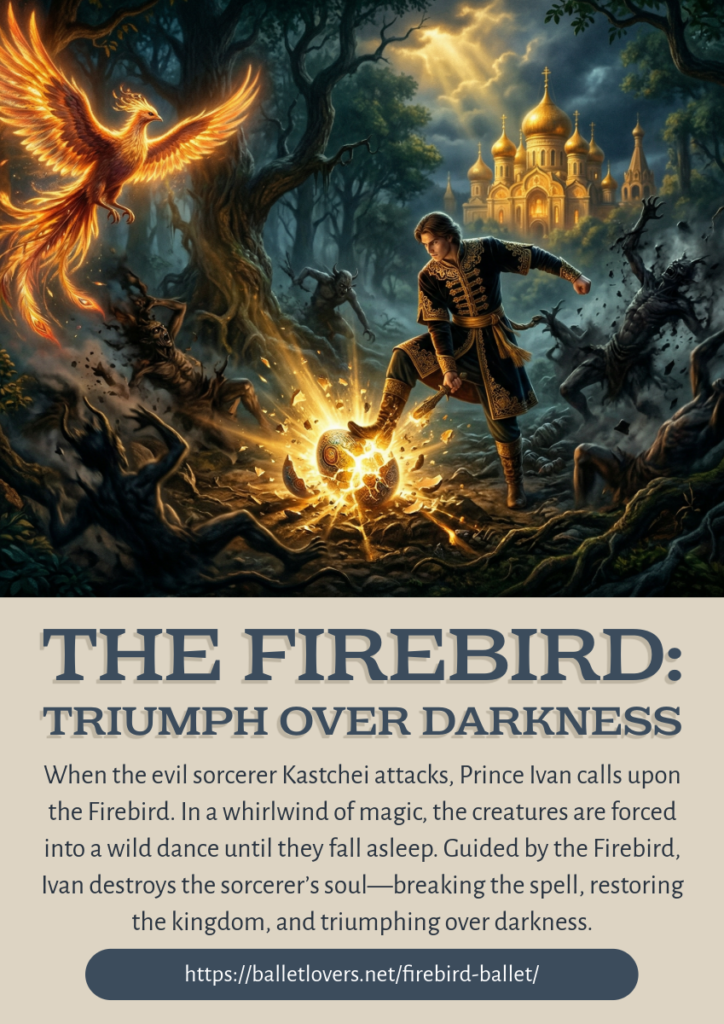
Ivan is invested with these symbols of power, marries the Tsarevna, and is acclaimed sovereign of the restored kingdom. In some versions, the evil kingdom is transformed into a Christian city with bulbous-domed churches. The Firebird departs, having fulfilled its mission. The ballet concludes with a triumphant ending, symbolizing the triumph of good over evil.
Conclusion
This plot presents the opposition between good and evil. So, the Firebird embodies light and beauty, Kastchei and his Impure Kingdom represent ugliness and malice, while Ivan and the princesses symbolise humanity. Fokine’s libretto offers opportunities for a variety of dances: classical ballet for the dazzling Firebird, grotesque movements for the monsters, and free dance for the delicate princesses. The story unfolds without conventional mimed gestures; only action and dance convey the narrative, from Ivan’s stealthy approach to the triumphant coronation.
You Might Also Like ✨


The Premiere of The Firebird Ballet
- Choreography: Mikhail Fokine
- Music: Igor Stravinsky
- Design: Aleksandr Golovin (scenery), Léon Bakst and Aleksandr Golovin (costumes)
- Libretto: Mikhail Fokine
- First Production: Diaghilev’s Ballets Russes, Théatre National de l’Opéra, Paris, 25 June 1910
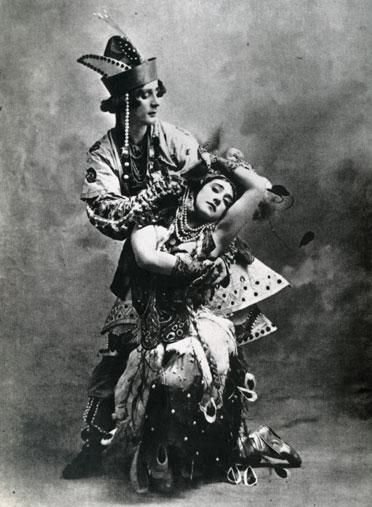
- Principal Dancers: Tamara Karsavina (Firebird), Mikhail Fokine (Ivan Tsarevich), Enrico Cecchetti (Köstchei), Vera Fokina (Tsarevna)
The creation of The Firebird was a prime example of close artistic collaboration. Diaghilev was looking for a purely national ballet, based on Russian folklore, for the 1910 Paris season. Fokine, drawing inspiration from the works of Alexander Afanasiev and other folk tales, crafted the libretto by combining these stories, as no unified narrative existed.
Initially, Fokine considered adding elements such as the Horseman of the Night and Morning, petrified monsters scattered throughout the garden, a carved golden fence, and a high stone wall protecting Kastchei Castle. Also, the firebird’s feather replaced an earlier idea of a magical gusli (a traditional slavic instrument), suggested by designer Alexandre Benois (1870-1960).
A Unique Collaborative Process
As for the music, Diaghilev initially contacted the composer Anatole Liadov. However, Liadov worked too slowly. So, Diaghilev proposed a young and relatively unknown Russian composer: Igor Stravinsky (1882-1971). Despite the initial limited success of Stravinsky’s early works, Diaghilev and Fokine recognised the originality and energy of his music. They believed it perfectly complemented the ballet’s passionate, fantastical nature.
The collaboration between Fokine and Stravinsky was exceptionally close. Instead of working independently, the two artists developed the ballet together, shaping the music and choreography simultaneously. Stravinsky would present musical sketches, and Fokine would respond by demonstrating movements and scenes.
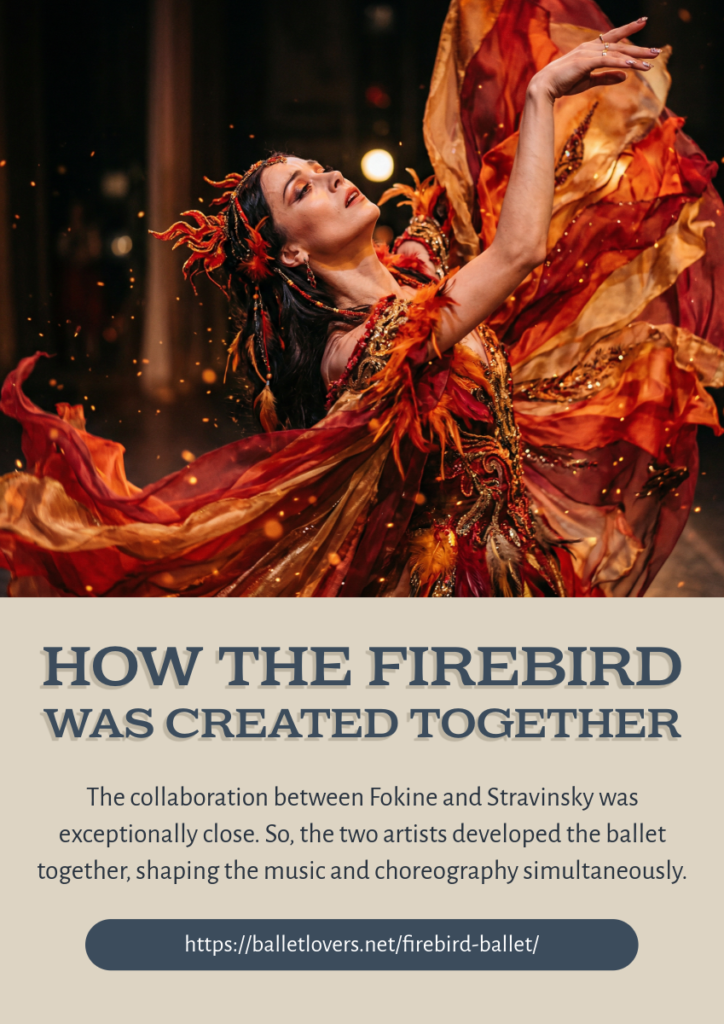
This interactive process allowed each artistic element to influence the other, resulting in a highly integrated work.
The set design and most of the costumes were entrusted to Russian stage designer Aleksandr Golovin (1863-1930). He created a garden resembling a Persian carpet with fantastical vegetation and a sinister castle in dark tones, adorned with gleaming golden apples.
On the other hand, the Russian Léon Bakst designed the Firebird’s original and fantastical costume (transparent oriental trousers, feathers, a headdress, and golden braids) and the Tsarevna’s attire. Enrico Cecchetti was chosen for the role of Kastchei, Vera Fokina for the Tsarevna, Fokine himself for Ivan, and Karsavina for the Firebird.

Production Challenges and Premiere
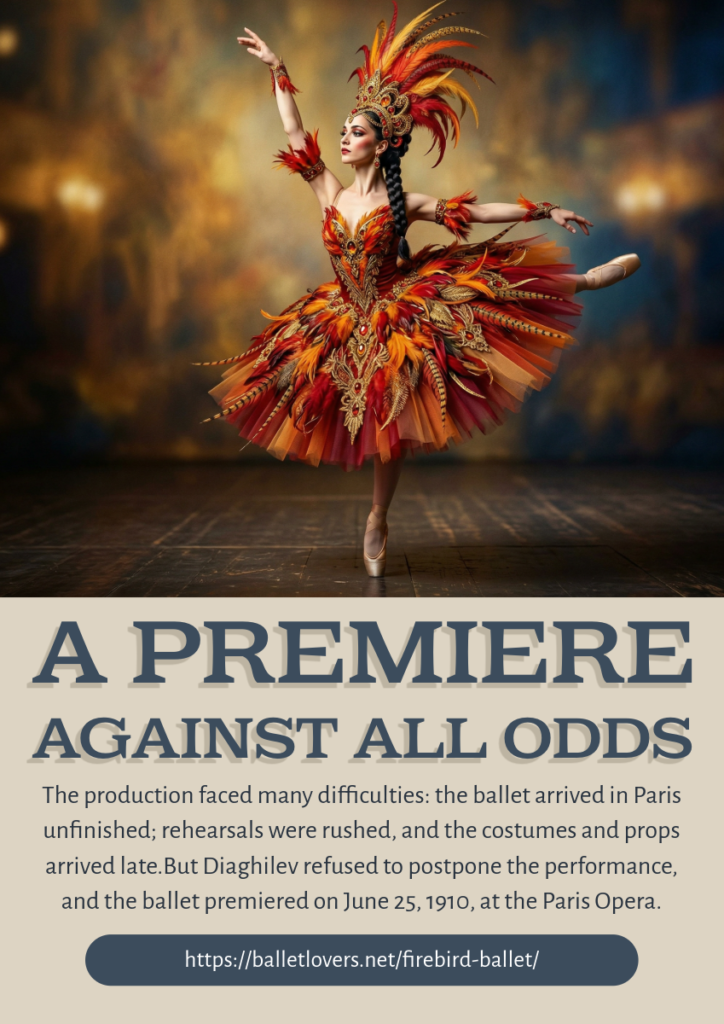
However, the production faced many difficulties: the ballet arrived in Paris unfinished; rehearsals were rushed, and the costumes and props arrived late. To make matters worse, the lighting was inadequate, and the Firebird’s flying apparatus creaked loudly. Fokine feared failure and even wept, but the company’s enthusiasm prevailed.
At the dress rehearsal, many elements remained incomplete. But Diaghilev refused to postpone the performance, and the ballet premiered on June 25, 1910, at the Paris Opera. Despite all the difficulties, the ballet was a resounding success and marked the beginning of Stravinsky’s international fame.
Later, in 1926, Diaghilev commissioned new sets and costumes from Natalia Goncharova, transforming the garden into a dark apple orchard and the finale into a Holy City of gilded onion domes.
Versions of the Firebird Ballet
Stravinsky’s score has inspired numerous choreographers to create their own versions. These generally fall into three categories: those that follow Fokine’s storyline, those that retain the fairy-tale plot without the Russian folklore, and those that present entirely new narratives.
Among the revivals faithful to the original spirit are Adolph Bolm’s for Ballet Theatre (1945), Serge Lifar’s for the Paris Opera Ballet (1954), and the Sadler’s Wells Ballet production by Serge Grigoriev and Lubov Tchernicheva (1954), which used Goncharova’s 1926 designs and featured Margot Fonteyn in the role of the Firebird.
George Balanchine’s version
George Balanchine’s version (1949), created for the New York City Ballet with Maria Tallchief in the title role, prioritised dance over narrative. Maria Tallchief performed the Firebird, wearing a red tutu and Marc Chagall’s jewel-toned designs. In 1970, Balanchine revised the work with choreographer Jerome Robbins (1918–1998), and the Firebird role was taken over by Gelsey Kirkland. A 1972 attempt to use a more literal “bird-headed” costume for the Firebird proved too restrictive. So it was eventually abandoned in favour of Tallchief’s original red tutu.
Futuristic and Symbolic Versions
Other versions retain the fairy-tale plot but change the setting. John Neumeier’s 1970 Frankfurt Opera Ballet set the action in a futuristic world where Kastchei is an evil robot. The hero destroys a valve to restore human forms. His 1983 version for the Vienna State Opera presented Kastchei as a malevolent robot with a deadly wand; a soldier and a girl defeat him, reviving a dying sun and causing a protected flower to bloom into a tree.
On the other hand, Vicente Nebrada’s 1982 Winnipeg Royal Ballet production included a light show, with a red Firebird confronting a turbaned magician and three-bodied reptiles. John Taras’s 1982 Dance Theatre of Harlem production set the story in a tropical rainforest, using universal symbols: the Young Man, the Princess of Unreal Beauty, and the Prince of Evil.
Modern Interpretations
Some productions completely discard the Russian elements to create new plots, while retaining the theme of good versus evil. Maurice Béjart’s 1970 Paris Opera Ballet (later Ballet du XXe Siècle) presented a male Firebird in red tights leading the revolutionaries to victory. He dies, but a successor arises, like a phoenix, transforming the group into Firebirds dressed in red. Glen Tetley’s 1981 Royal Danish Ballet depicted a young woman oppressed by a father figure and her governesses. She encounters a young woman who fights for her in a garden of leaping grey creatures, emerging triumphant, dressed in bridal white. Minimalist adaptations also emerged.
Ferenc Bartók’s pas de deux for two men (The Firebird and The Sorcerer), premiered in Munich in 1981, used Isao Tomita’s synthesiser arrangement on an empty stage. Brian Macdonald’s versions for the Royal Swedish Ballet and Harkness, which premiered between 1966 and 1967, added two Reflections with identical costumes. These adaptations demonstrate the score’s flexibility. Even in traditional productions, the visual elements evolved. In 1926, Natalia Goncharova redesigned the sets and costumes, offering a new aesthetic interpretation.
Critiques of the Ballet
Since its premiere in 1910, The Firebird has been hailed as a masterpiece. But despite its success, The Firebird has not been without its critics.
Contemporary critics and later observers praised The Firebird lavishly. French reviewers in 1910 called it a “sumptuous and novel decor” evoking “the picturesque, strange, and invincible charm of the tales of Slavic mythology.” One noted its “artless and wonderful” fable, “chirping tones,” and “delirium of the dance,” plunging viewers into “the ecstasy of the stories of our childhood.” Another declared it “the most complete, the most beautiful spectacle” yet from the Ballets Russes, free from traditional fetters and raising new problems in choreographic aesthetics.
English critics admired Stravinsky’s score, which fitted the action “like the proverbial glove.” Karsavina’s portrayal was “unforgettable” for its “grace and fleetness,” “palpitating fear and violated purity.” The famous British critic Cyril Beaumont preferred Karsavina’s original fantastic costume over later orange-and-yellow versions.
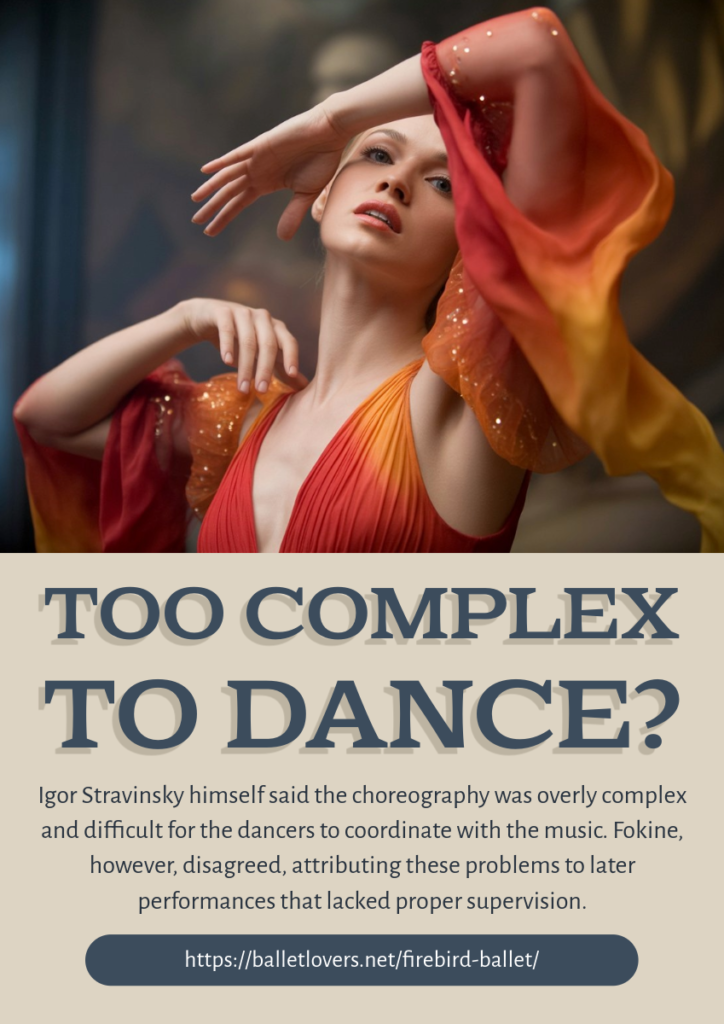
Igor Stravinsky himself said the choreography was overly complex and difficult for the dancers to coordinate with the music. Fokine, however, disagreed, attributing these problems to later performances that lacked proper supervision. Fokine also criticised subsequent productions that altered his original vision. He believed that many performances had lost the ballet’s expressive power and coherence, becoming mechanical and lacking emotional depth.
The changes introduced by Diaghilev also drew criticism. For example, modifications to the set design and staging sometimes disrupted the narrative logic, making certain actions seem pointless. Even the technical aspects of the production presented difficulties.
Some stage effects, such as the Firebird’s attempt at flight, were unsuccessful and detracted from the overall illusion. Despite these criticisms, ballet’s strengths have ensured its enduring popularity.
Conclusion
Despite Fokine’s personal disappointment with the later modifications, The Firebird remains one of the most significant works in the history of ballet. Its survival for over a century and its ability to “challenge the imagination of choreographers” confirm its greatness. Also, while Stravinsky composed more original works, none equalled The Firebird in poetry and beauty.
Bibliography
- Beaumont, Cyril W. Michel Fokine & His Ballets. London: C.W. Beaumont, 1935.
- Fokine, Michel. Memoirs of a Ballet Master. Boston: Little, Brown and Company, 1961.
- Kochno, Boris. Diaghilev and the Ballets Russes. London: Faber and Faber, 1970.
- International Dictionary of Ballet. Detroit: St. James Press, 1993.
- International Encyclopedia of Dance. New York: Oxford University Press, 1998.
- Brinson, Peter. Ballet and Dance: A Guide to the Repertory. London: Faber and Faber, 1980.


Leave a Reply