
Jean Dauberval, whose birth name was Jean Bercher, was a prominent French dancer and ballet master. He was born in Montpellier, France, on August 19, 1742, and died in Tours, France, on February 14, 1806. He is best known for creating the ballet La Fille Mal Gardée.
This is one of the oldest and most enduring ballets in the current international repertoire. Also, it’s among the first to feature realistic characters rather than mythological ones. In this article, we’ll tell you about his life, his works, and his legacy.
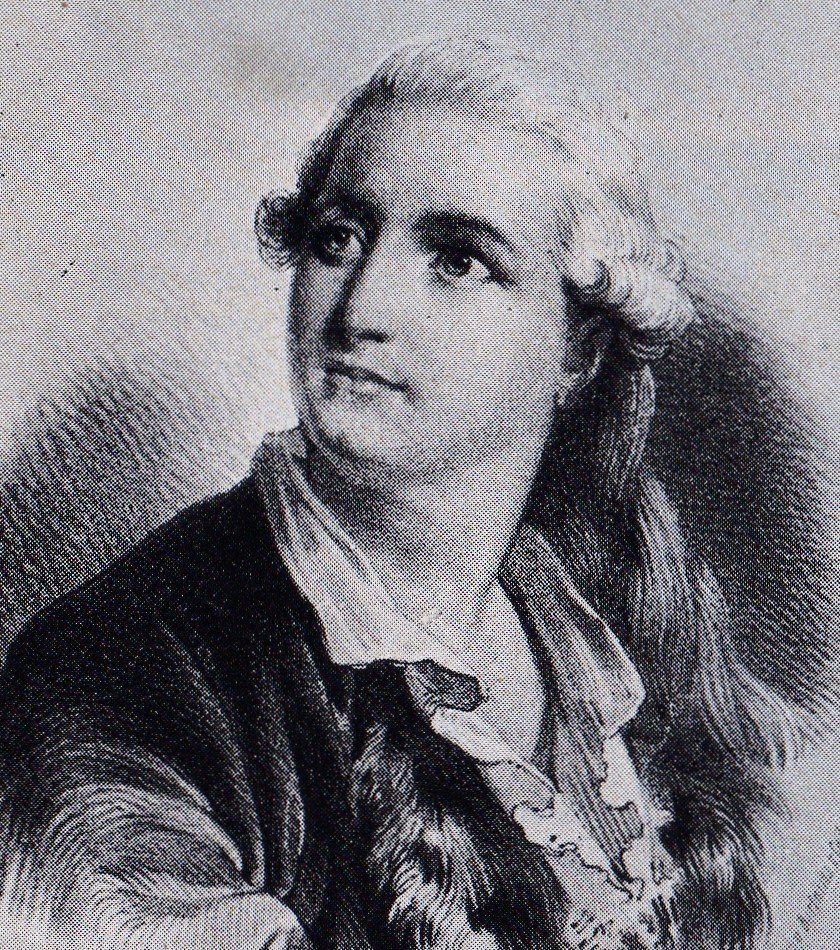
Table of Contents
Education and Early Life of Jean Dauberval
Jean Dauberval was born in Montpellier, France, in 1742, during the reign of Louis XV. The son of an actor, he spent his childhood in a theatrical environment. He was deeply influenced by the Rococo style of his youth, identifying with the elegant joy of the works of painters such as Boucher and Fragonard. This environment encouraged his development as a great dancer. And he formally studied ballet with the renowned master Jean-Barthélemy Lany (1718–1786) at the Paris Opera.
Years later, he studied ballet with the famous master Jean-Georges Noverre (1727–1810). Noverre was the pioneer of “ballet d’action,” a form of ballet that held that ballets should tell a story and use the body to express emotions through gestures and mime.
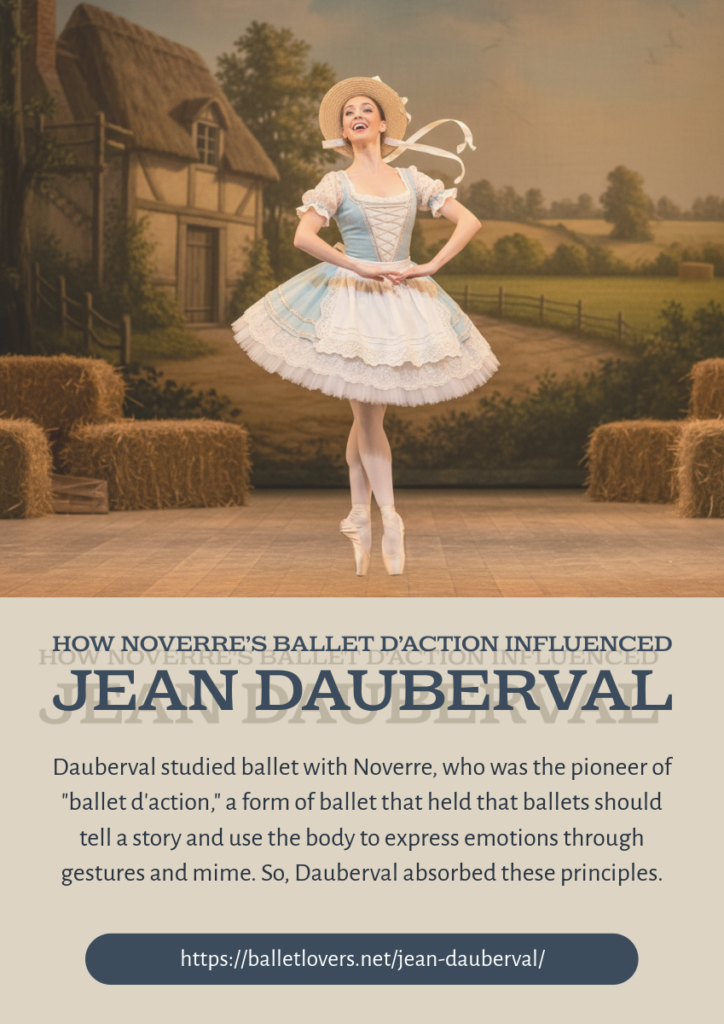
So, Dauberval absorbed these principles, which would later become central elements of his own choreographic style.
KEY INFO
Ballet d’action introduced a storytelling through movement. Dance and mime became central to the plot. So, dancers used facial expressions and gestures to convey feelings. Also, the ballet followed a clear, logical plot.
Jean Dauberval: Personal Life
Jean Dauberval was known for his good humour and elegant manners. These qualities allowed him access to the highest echelons of society, including the patronage of Madame du Barry (mistress of King Louis XV of France).
His personal lifestyle was quite extravagant, as evidenced by his sumptuous Parisian residence, which included a salon that could be converted into a theatre. Despite his own extravagances and frequent debts, he was remarkably generous to fellow artists during difficult times.
In 1783, he married the dancer Marie-Madeleine Crespe, known professionally as Mademoiselle Théodore. This dancer was not only his wife but also maintained a professional relationship with Dauberval.

She played leading roles in his works, including the original production of La Fille mal gardée. Their collaboration reflects the close artistic relationships common in 18th-century ballet companies. She was an intellectual figure in the theatrical world. She was known as the “philosopher of the stage,” who collaborated closely with him until her death in 1796.
Jean Dauberval: Dancer, Choreographer, and Ballet Master
Dauberval began his career at the Paris Opera in 1761 and spent the next twenty-one years there. His rise was meteoric. He quickly ascended from corps de ballet dancer to premier danseur demi-caractere (1763)and to soloist (1764). And finally, to premier danseur noble in 1770. He was also engaged as a principal dancer in Stuttgart in 1762 and 1763 and at Covent Garden in 1763 and 1764.
But Dauberval distinguished himself not so much as a dancer as he did as a choreographer. During his time in Stuttgart, he met the prestigious choreographer Noverre, who instilled in him a view of ballet as a dramatic art form. Years later, in 1772, Dauberval became an assistant ballet master at the Paris Opera alongside Maximilien Gardel, the first dancer to appear on the Paris Opera stage without a mask.

Dauberval was very talented, and many anticipated that he would soon become the ballet master of the Paris Opera. But when Gaetan Vestris retired as ballet master, Noverre was chosen for this coveted position, thanks to his connection with Marie Antoinette (who had been Noverre’s student). Noverre eventually retired in 1781, and Dauberval and Gardel shared the position. However, the relationship between these two masters was strained, so in 1783, Dauberval decided to resign.
You Might Also Like ✨

The Creation of La Fille Mal Gardée
But thanks to his prestige and experience gained at the Paris Opera, Dauberval easily secured a position at the King’s Theatre in London for the 1784 season. In 1785, Dauberval and his wife moved to Bordeaux. There, Dauberval began the most productive period of his career. Only the Paris Opera surpassed the Grand Théâtre in Bordeaux in the quality of its productions. On the other hand, the theatre’s management allowed Dauberval the freedom of artistic creation that he would never have enjoyed at the Paris Opera.
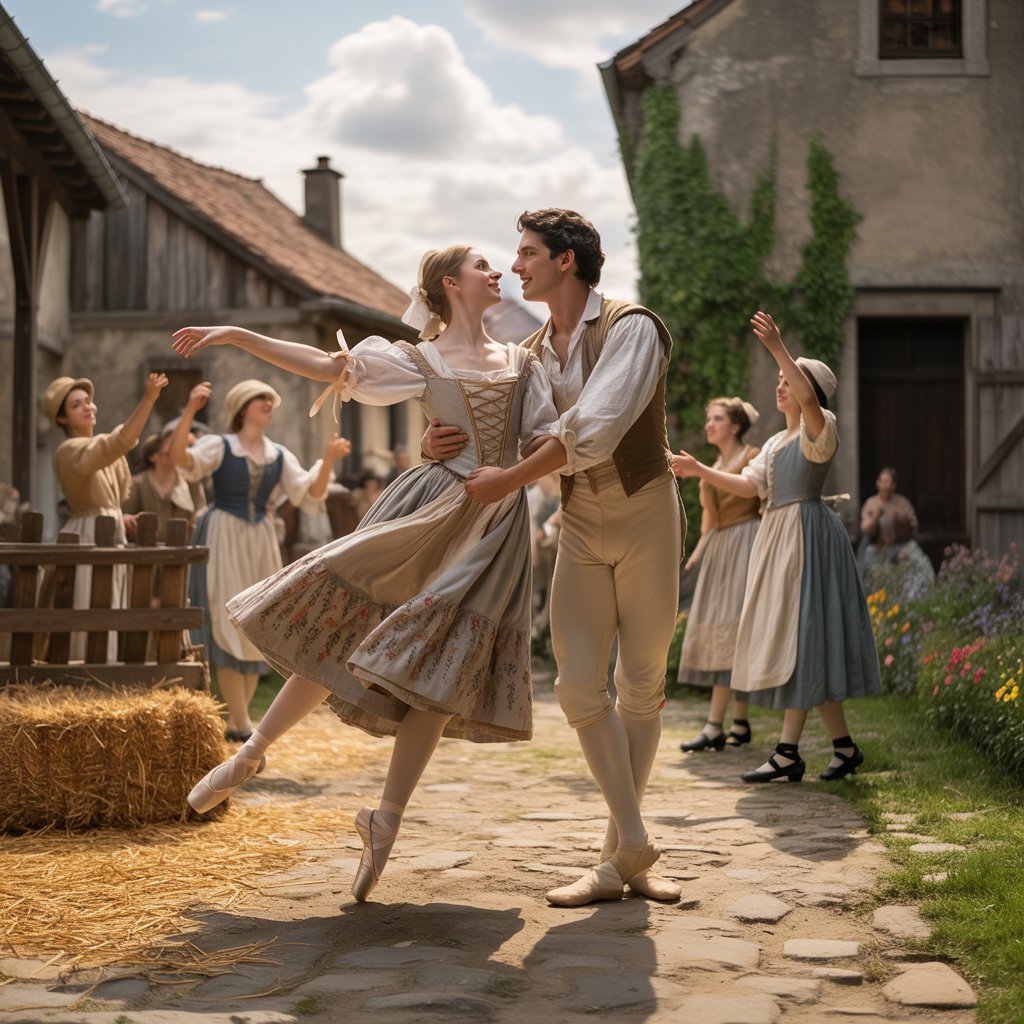
It was in Bordeaux that Dauberval created two of his most popular works: La Fille Mal Gardée and Le Page In Constant. Let’s remember that La Fille Mal Gardée is one of the oldest ballets still performed today. This ballet premiered on July 1, 1789, under the title Le Ballet de la Paille, ou Il N’est qu’un Pas du Mai au Bien (Ballet of Straw, or It Is Only One Step from Bad to Good). In 1790, Dauberval left Bordeaux and returned to London in 1791, where he formed a prestigious company.
Unlike many ballets of the time, which focused on gods and aristocratic figures, Dauberval chose to portray peasants and domestic comedy, making the ballet more relatable to the public. The great ballet master died in Tours in 1806.
The Most Famous Works of Jean Dauberval
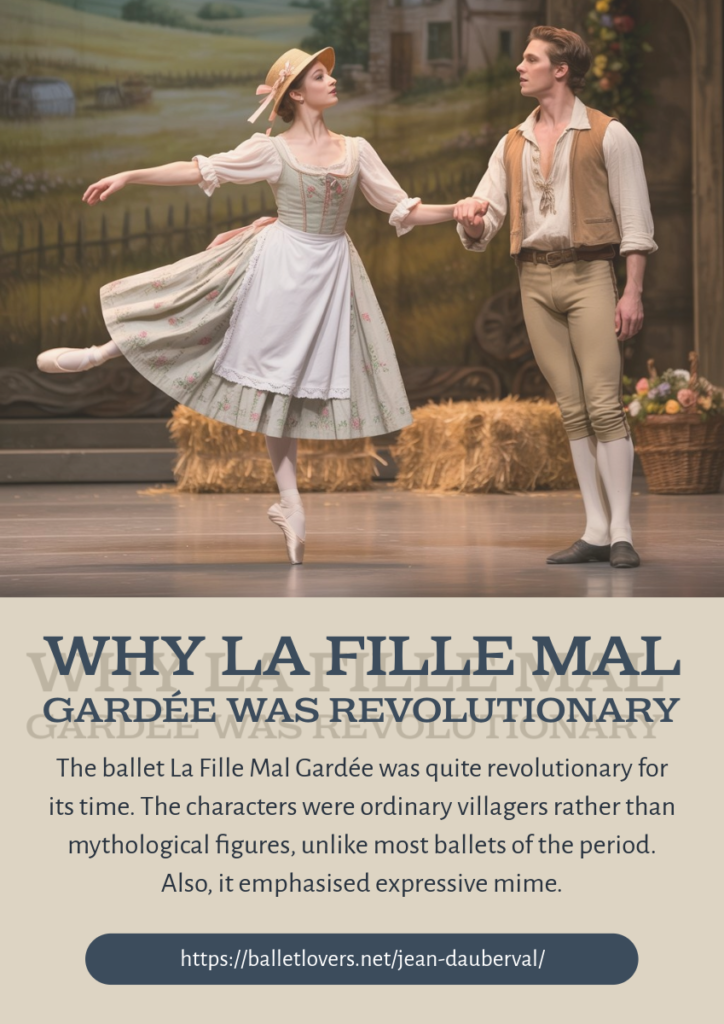
Without a doubt, Dauberval’s most famous work is La Fille Mal Gardée. Besides being Dauberval’s masterpiece, it is one of the oldest ballets still performed in the current repertoire of major theatres worldwide. It premiered in Bordeaux in 1789 and tells a story of love and betrayal in a rural setting. The ballet was quite revolutionary for its time, breaking many conventions in various ways. At first, the characters were ordinary villagers rather than mythological figures, unlike most ballets of the period. Also, it emphasised expressive mime.
Other notable works include:
- Le Déserteur, ou La Clémence Royale (1784): A highly dramatic ballet introduced in London. It’s known for its gripping story of a lover saved from a firing squad.
- Le Page Inconstant (1787): A version of Beaumarchais’s The Marriage of Figaro.
- Psyché (1788) and Telemachus in the Island of Calypso (1791): Examples of his more serious and neoclassical output.
The Legacy of Jean Dauberval
Jean Dauberval’s principal legacy lies in his refinement of the ballet d’action. Thanks to the influence of Noverre, Dauberval was the first to successfully integrate pantomime and dance so completely that dance became essential to the plot.
Dauberval is also credited with abolishing the use of masks. Following the example of his contemporary Gardel, he helped ballet adopt more natural facial expressions and realistic costumes. He also made a clear distinction between “character dance” (derived from folk traditions) and “dances of character”. The last ones depict specific, unique roles, such as Alain in La Fille Mal Gardée. Besides, Dauberval was a teacher to talented choreographers. For example, Salvatore Viganò, Charles Didelot, and Jean-Louis Aumer.
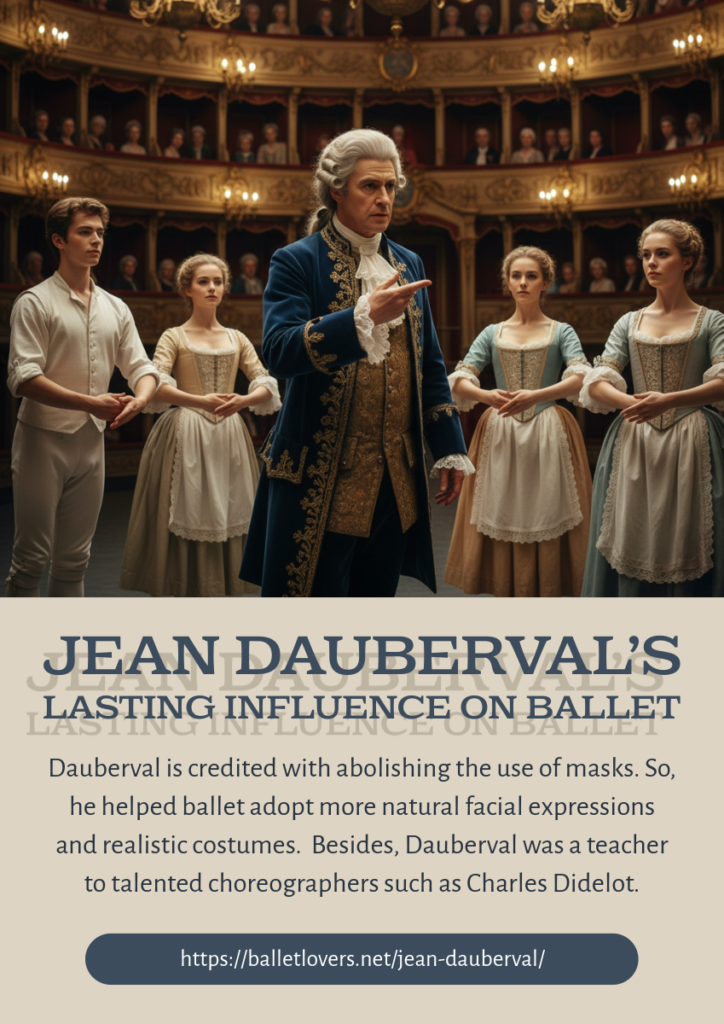
Finally, his famous work La Fille Mal Gardée remains essential in the classical ballet repertoire, performed by major companies worldwide. Thanks to this work, Dauberval secured a permanent place in the history of ballet. His work marked the transition from the decorative ballets of the past to the expressive ballets that would define the 19th century.
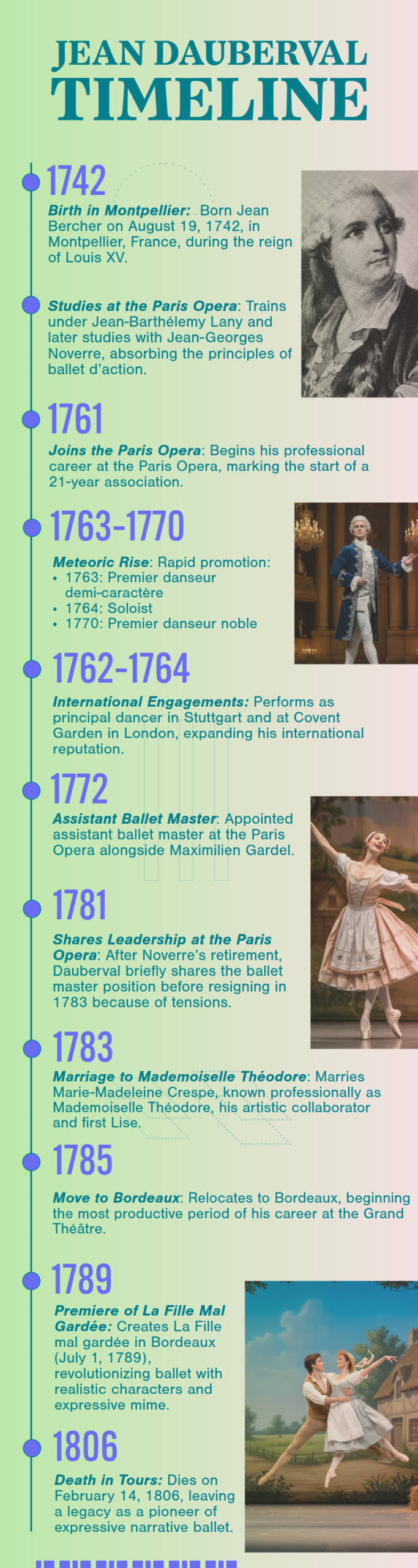
Jean Dauberval Biography Timeline
Bibliography
- International Encyclopedia of Dance: A Project of Dance Perspectives Foundation, Inc. New York: Oxford University Press, 1998.
- International Dictionary of Ballet. Detroit: St. James Press, 1993.
- Chujoy, Anatole, ed. The Dance Encyclopedia. New York: Simon and Schuster, 1967.
- Craine, Debra, and Judith Mackrell. The Oxford Dictionary of Dance. Oxford: Oxford University Press, 2000.


Leave a Reply