
Raymonda stands as a dazzling late 19th-century ballet. First performed in 1898 at the Mariinsky Theatre in St. Petersburg, it represents the last great work of the legendary choreographer Marius Petipa, in collaboration with the composer Alexander Glazunov. The ballet consists of three acts and four scenes, set in medieval Hungary during the Crusades. Raymonda is renowned for its score and brilliant choreography, which have ensured its enduring appeal. However, its story was considered absurd, difficult to follow, and, according to some ballet aficionados, “has everything but meaning.” Despite this, Raymonda has evolved through various versions and adaptations, and today it remains an essential work of the classical repertoire.
If you are interested in learning more about the history, plot, and different versions of Raymonda, continue reading this article.
Table of Contents
How Raymonda Ballet Was Created (The Premiere)
- Choreography: Marius Petipa
- Music: Aleksandr Glazunov
- Design: Orest Allegri, Konstantin Ivanov, Petr Lambin (sets), Ekaterina Ofizerova, Ivan Kaffi (costumes).
- Libretto: Lydia Pashkova and Marius Petipa
- First Production: Maryinsky Theatre, St. Petersburg, 19 January (7 January old style) 1898
- Principal Dancers: Pierina Legnani (Raymonda), Sergei Legat (Jean de Brienne), Pavel Gerdt (Abderakhman, or “Abderame”)
Raymonda’s creation started in 1895 when Lydia Pashkova, a social columnist and novelist, sent a new ballet libretto to Ivan Vsevolozhsky, who led the Imperial Theatres of Russia. Vsevolozhsky made some changes and gave it to the well-known choreographer Marius Petipa (1818-1910). Petipa had already created many famous ballets, like Don Quixote and The Sleeping Beauty. Even though he was nearly eighty, he took on the project and began working on what would be his last great ballet.
The music for Raymonda was written by the young composer Alexander Glazunov (1865-1936), making this his first ballet. At the time, Glazunov was not as famous as composers like Tchaikovsky, who had died in 1893, but Raymonda became one of the highlights of his career. Later on, George Balanchine called this music some of the best ever written for ballet.
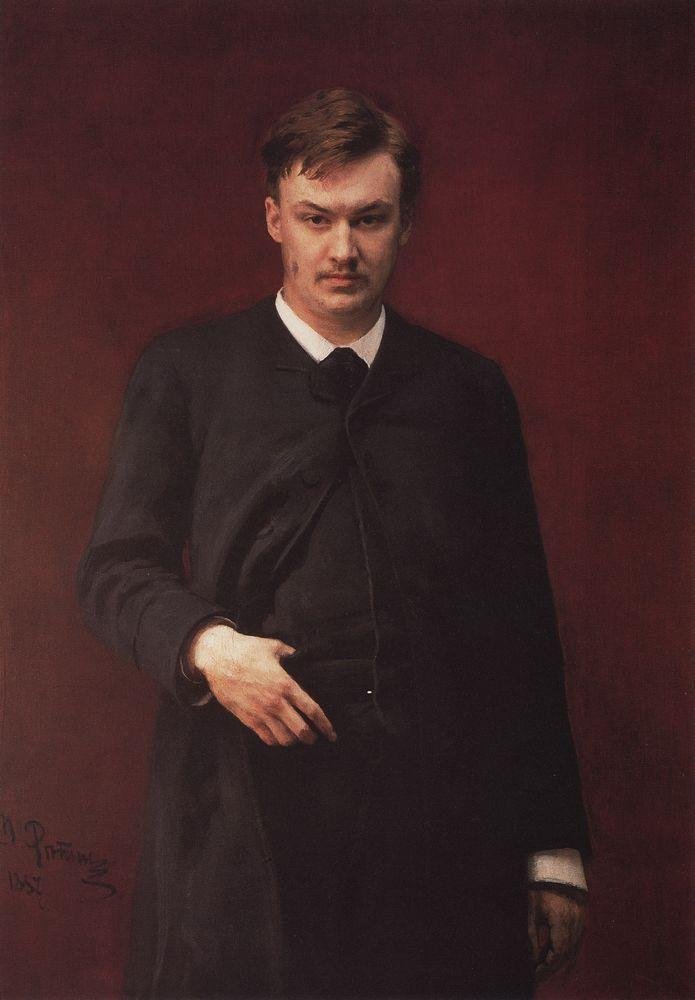
He highlighted its Russian style, melody, and romantic feel. Glazunov created the score in a new way, using a series of suites that mix demi-caractère, classical, and character styles across all three acts.
The Premiere
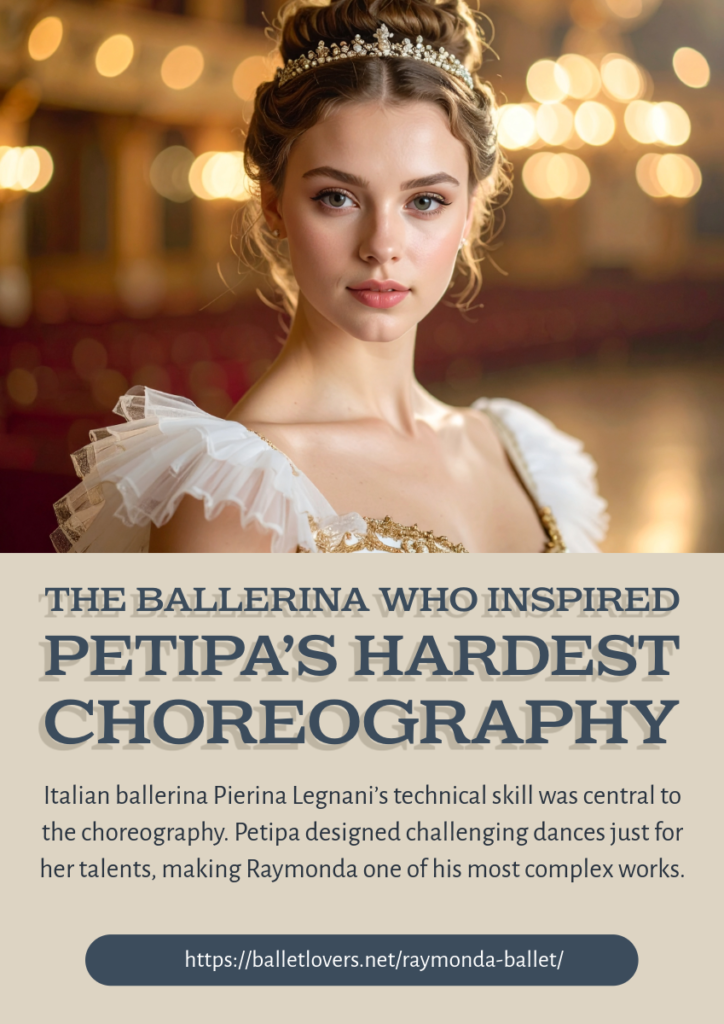
It took about three years to finish the ballet before its first performance. The premiere was held on January 19, 1898 (January 7 in the old calendar) at the Mariinsky Theatre in St. Petersburg. The event was a benefit gala for the Italian ballerina Pierina Legnani, who danced the role of Raymonda. Sergei Legat played Jean de Brienne, and Pavel Gerdt played Abderakhman. Legnani was one of the most skilled dancers of her era and was known for introducing the 32 fouettés in Swan Lake.
Legnani’s technical skill was central to the choreography. Petipa designed challenging dances just for her talents, making Raymonda one of his most complex and polished works. Even though he was older, Petipa proved he was still at the height of his creativity.
The first performance of Raymonda marked the end of an era. It was Petipa’s last big full-length ballet before the Imperial Ballet system began to decline and before the political changes of the early 1900s. It was also his final major work before he died in 1910. For Glazunov, this was his first ballet as a composer. Raymonda soon became part of the Mariinsky (later Kirov) and Bolshoi repertoires and is still a key part of Russian ballet today.
You Might Also Like ✨

Raymonda Ballet Plot
The libretto, mainly written by Lydia Pashkova with Petipa’s help, is often seen as the ballet’s weakest part. Many people find the story confusing and hard to follow. The setting shifts between medieval Provence and Hungary, but the main plot centres on Raymonda, her fiancé, Jean de Brienne, a knight returning from the Crusades, and the Saracen chieftain Abderakhman, who becomes obsessed with Raymonda.
Act I: The Birthday and the Vision
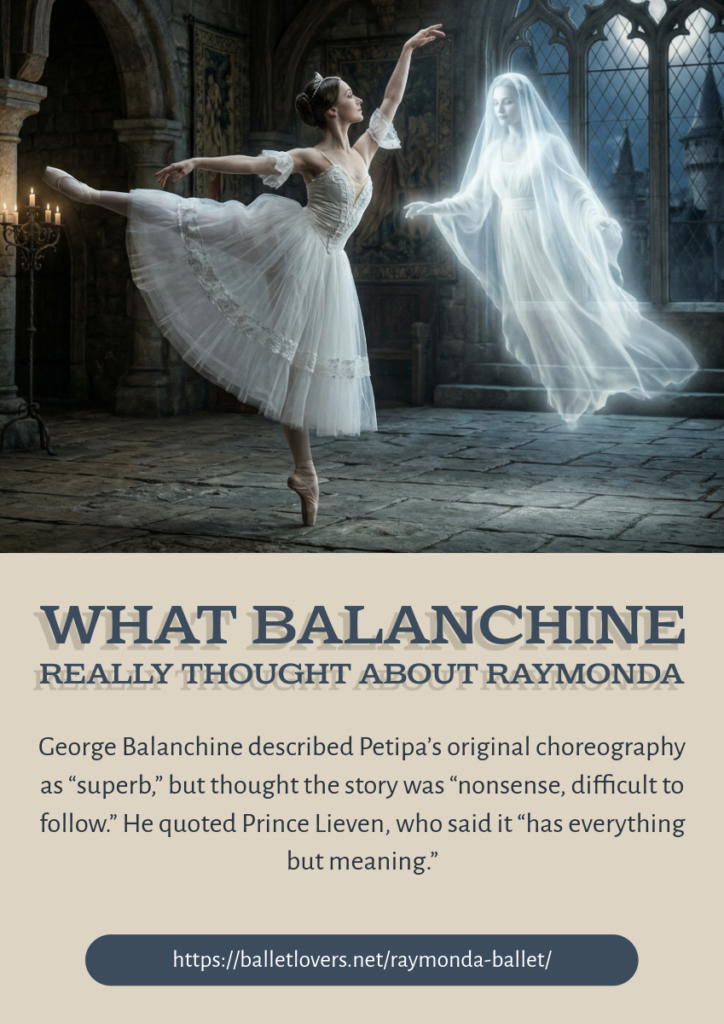
Scene 1: It takes place at the castle of Countess Sybille, who is Raymonda’s aunt. It is Raymonda’s birthday. The Countess warns everyone about the statue of the White Lady, a ghostly ancestor who protects the family and punishes those who break tradition. A messenger brings a letter from Raymonda’s fiancé, Jean de Brienne, saying he will return soon from the Crusades. Then, Abderakhman, a Saracen chieftain, arrives unexpectedly. He quickly falls in love with Raymonda and offers her gifts and his affection, but she refuses him. Even though Raymonda feels uneasy, the Countess invites Abderakhman to stay for the celebration. Raymonda plays the lute and falls asleep. The White Lady appears and leads her to the terrace.
Scene 2: Raymonda dreams that Jean de Brienne appears and speaks to him They dance a grand adagio together. Afterwards,there is a divertimento with Jean’s attendants and spirits. The dream turns into a nightmare when Jean disappears, and Abderakhman takes his place, chasing Raymonda and declaring his love. Raymonda is horrified and pulls away. Elves and sprites join in a lively dance. Raymonda faints and collapses. At dawn, her attendants find her and carry her back to the castle.
Act II: The Courtyard and the Duel
It takes place in the courtyard during a grand reception for the returning knights. Abderakhman stays behind and continues to pursue Raymonda. He brings dancers from the Orient and Spain to impress her. The guests are distracted by wine and dancing. Taking advantage of the moment, Abderakhman tries to kidnap Raymonda. Just in time, Jean de Brienne arrives with King Andrew the Second of Hungary. The king orders a duel to settle the conflict. The White Lady appears and weakens Abderakhman with her magic. Jean defeats and kills Abderakhman. The king then joins Jean and Raymonda’s hands in celebration.
Act III: The Marriage and Festival
It is about the marriage and celebration. At Jean de Brienne’s castle, King Andrew and the newlyweds watch a grand Hungarian divertimento held in their honour. There are many dances, a final gallop, and a spectacular tournament. In some versions, this act also includes a ceremonial procession and the famous Grand Pas Classique Hongrois, in which classical ballet steps are combined with Hungarian folk gestures. The story ends with Raymonda and Jean united in love, protected by the White Lady.
Famous Versions of Raymonda Ballet
Raymonda has been revised many times because of problems with its libretto. Choreographers tried to fix these issues while keeping Petipa’s choreography and Glazunov’s music. The ballet has remained in the Kirov repertoire and was often reinterpreted during the Soviet era.
Russian Developments
Earlier productions were staged by Ivan Clustine and Aleksandr Gorsky for the Bolshoi in 1900, both based on Petipa’s version. Gorsky later created his own version in 1908, changing Jean’s variation and pas de deux, removing the symmetrical corps de ballet and tutus in some scenes, and turning Abderakhman from a warrior into a merchant. Later, Anna Pavlova performed a shortened version by Clustine in 1914,
Raymonda Ballet in the Soviet Era
In the Soviet era, Agrippina Vaganova staged a new version in 1931 for the Kirov (then called GATOB). Years later, in 1938, Vasily Vainonen and Yuri Slonimsky created another version with a very different libretto. They switched the order of Acts II and III, moved some variations, added new scenes, and made Abderakhman a positive hero while Jean became the villain. Galina Ulanova played Raymonda. This version did not succeed because the music did not fit the new characters.
Konstantin Sergeyev’s 1948 version for the Kirov Theatre, with sets by Simon Virsaladze and Natalia Dudinskaya as Raymonda, was more successful. He stayed closer to the original choreography, replaced the duel and ceremonial procession with a honeymoon scene set
against a moving backdrop, and recreated many dances from Act I. In this version, Jean appears as a tapestry in Act I.
Yuri Grigorovich’s Raymonda (1984)
Yuri Grigorovich’s 1984 production for the Bolshoi Theatre, also with sets by Virsaladze, is seen as one of the best. Natalia Bessmertnova played Raymonda. Grigorovich focused on Raymonda’s inner struggle between sensual and spiritual sides, rather than a conflict between characters. He added an opening scene in which Jean leaves for the crusade, reduced the pantomime, made the dramatic action stronger by involving the main characters in the divertissements, treated the dream sequence as a farewell and memory pas de deux, and used choreography to show the symphonic interlude. Abderakhman became a noble and charming warrior, while Jean was an ascetic knight. Raymonda is the main focus, appearing in the codas of each suite.
Western Interpretations
In the West, full-length productions of Raymonda have been less common and have not lasted as long. Rudolf Nureyev first staged his version for the Royal Ballet Touring Company at the Spoleto Festival in 1964 with Doreen Wells and himself. He later restaged it for the Australian Ballet in 1965 with Margot Fonteyn and for American Ballet Theatre in 1975. Nureyev’s versions reduced pantomime, gave Abderakhman his own variation, and highlighted male dancing. The Royal Ballet also performed an expanded version of Nureyev’s third act.
In contrast, George Balanchine and Alexandra Danilova made a shorter, three-act version for the Ballet Russe de Monte Carlo in 1946. Later, Balanchine created pure dance pieces from the score for the New York City Ballet: Pas de Dix (1955), Raymonda Variations (originally Valse et Variations, 1961, with no story and featuring an adagio and nine variations), and Cortège Hongrois (1973). These works focus on classical style with Hungarian touches and do not follow the original story.
Other important productions include Tatjana Gsovsky and Nicholas Beriozoff’s version for the German Opera Ballet in 1975, as well as several shorter pieces that highlight the Grand Pas Hongrois.
Critiques and Legacy
Raymonda is often acclaimed for its music and choreography, but critics have shown concerns about the story. Ballet writer Peter Brinson described the plot as a “farrago whose complications and inadequacies are barely comprehensible” and “idiotic though this scenario is.” Still, he called the ballet “a glorious work” with a “magical score” full of melody, colour, and grand effects that inspired Petipa’s last masterpiece. The choreography, kept alive in Nureyev’s versions, has been called “dazzling” and has an “autumnally golden” quality.
Reviewers of Nureyev’s productions were especially positive about the dancing. Alexander Bland praised David Wall’s Raymonda solo in the Royal Ballet Touring Company, saying it showed “dash, control, musicality, and style” that matched any
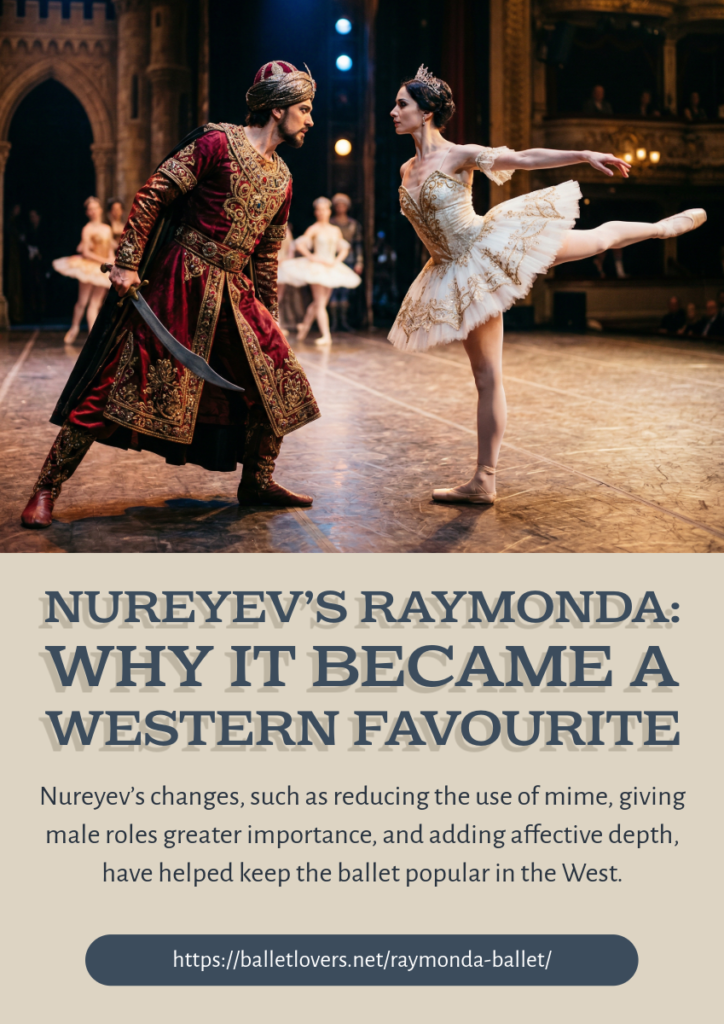
Kirov dancer and helped make Wall a top British talent. Nureyev’s changes, such as reducing the use of mime, giving male roles greater importance, and adding affective depth, have helped keep the ballet popular in the West.
Why Raymonda’s Story Has Been Criticised
George Balanchine described Petipa’s original choreography as “superb,” but thought the story was “nonsense, difficult to follow.” He quoted Prince Lieven, who said it “has everything but meaning.” Balanchine especially admired Glazunov’s music, calling it one of the best for ballet—grand, generous, joyful, and playful—enough to support the dances by itself. His own works, like Raymonda Variations, highlight this musical richness without including the plot.
Ballet historian Cyril W. Beaumont and others describe the plot as complicated, with mime, supernatural elements, and a final apotheosis. They note that the gap between the beautiful dancing and the odd story is why many companies perform only parts of the ballet. Dance historians Clement Crisp and Peter Brinson (cited in
the International Dictionary of Ballet) point out that the choreography is classic Petipa, focused on technical skill, but the weak story has led to later versions changing the story significantly.
Conclusion
Overall, Raymonda is appreciated for its beautiful music, Petipa’s creative choreography—especially the variations and grand pas—and its Hungarian divertissement, which mixes classical and character styles. Most of its problems come from the story, leading to many changes over time. Even so, the ballet is still a highlight for both lead dancers and the corps de ballet, with Raymonda as the shining focus. Its long run in Russian companies and its impact on Western versions show that its dance and music are much stronger than its story.
Bibliography
- Brinson, Peter. Ballet and Dance: A Guide to the Repertory.
- Balanchine, George. Balanchine’s New Complete Stories of the Great Ballets.
- International Encyclopedia of Dance. A project of Dance Perspectives Foundation, Inc.
- Beaumont, Cyril W. Complete Book of Ballets: A Guide to the Principal Ballets of the Nineteenth and Twentieth Centuries.
- International Dictionary of Ballet.


Leave a Reply